Showing posts with label origami. Show all posts

Thursday, October 1, 2015

Icosahedron with Curves


Icosahedron with Curves, by Meenakshi Mukerji

I don't have much to say about this one, except that it consists of 30 units.  Each unit takes one red piece of paper and one blue.  The red and blue are deliberately patterned in such a way so as to look chaotic.

Alas!  This is the only angle you will ever see, for this is the only photo I have of a now dead model.  When I moved apartments over a year ago, it was among those that did not survive.

I have no regrets.  Origami lives, and then dies.  As it is, I have too much "living" origami, and the amount of space it takes up is the biggest thing discouraging me from making more.  Probably the solution is to give more of it away as gifts.

Thursday, September 3, 2015

Dimpled model with curves

Here's one of the very earliest origami models I made, in fact the first 30 unit model.  At the time, I was more interested in documenting the process of creation, so I have a bunch of photos

Shown are 30 units of various colors.  These days I usually assemble the units together as I make them, instead of making them all first.

I assemble the units together in a dodecahedral pattern.

The last few pieces were the hardest.  I recall taking pieces out and putting them back in a few times.

Dimpled model with curves, from Exquisite Modular Origami by Meenakshi Mukerji

Looking back, the coloring of this model is interesting.  Many unique patterns are used, but they're arranged such that the dominant colors form somewhat of a symmetric pattern.  They don't form a "symmetric coloring" in the mathematical sense, but rather, colors shift from red to green to blue.  I feel this is actually more evocative than the mathematical symmetric coloring.

At the same time, I'm critical of the choice to use patterned paper.  There are some pretty curls in the paper, and between the curls and patterned paper it's too busy.

Saturday, August 1, 2015

A deconstruction of my research

Daisy Chains by Eric Gjerde.  Click for a larger version.  It's a hexagonal grid of 19 daisies.

So, here's another model in the category of origami tessellations.  One thing that makes these things difficult is that most of my origami paper is only 15x15 cm.  You can fold tessellations with that, but they're very small and it can be rather difficult.  But I have all these old disused research posters lying around the office, and I borrowed one.

I hung the result on my cubicle wall.  It's really big, but easy to overlook, so every so often someone else in the group notices it for the first time, and says "WOAH!"  That's no ordinary poster!

I probably appreciate this one more than anyone else because I actually know all about the research in the poster.  Yep, those Hi Tc pei ndors.  Waximum sunductisition teure of 13 cuprat onden phys. The layersi-2D st makes an be study tro opic eb str shown belo.

Saturday, July 4, 2015

Sierpinski Tetrahedron

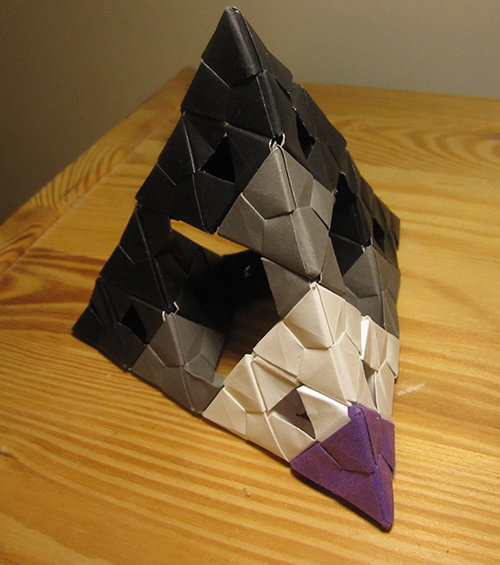
Sierpinski Tetrahedron, a model designed by me.  It also uses Equilateral Triangle Edge Modules by Lewis Simon & Bennett Arnstein.

Although I designed the particulars of the construction of this model, the idea of a Sierpinski Tetrahedron is not original.  It comes from one of the best-known fractals, the Sierpinski triangle.

Image borrowed from David Darling.

The Sierpinski triangle is constructed by taking three congruent triangles, and using them to form a larger triangle.  Then we take two more copies of the larger triangle, and use them to form an even larger triangle.  And repeat ad infinitum.

The sierpinski tetrahedron is a natural generalization, where you take four congruent tetrahedrons, and use them to form an even larger tetrahedron.  And then with four copies of the larger tetrahedron, we make an even larger one.  We stop there though, because 16 tetrahedra is enough to get the picture.

I'm also inspired by Tomoko Fuse's Unit Origami, where she shows ways to connect simple polyhedra together.  But what larger whole can I construct with lots of little polyhedra?  And so came the idea of the Sierpinski Tetrahedron.  All that remained was to design a connector so that the tetrahedra would stick together.  I'm not entirely satisfied with the connector design though, since it could stand to be more stable.

I tried searching for other connector solutions on the internet, and I found that most people just use tape.  Except for this one, which claims to use paper links.


But as I can plainly see, there are no connectors.  I think the website is lying to me.  You can't fool an origamist!

Monday, June 1, 2015

Origami disasters

People say I have talent for making origami.  Perhaps that's somewhat true, but I think the most important thing is that I like doing it.  Because I like doing it, I spend a lot of time on it and accumulate a lot of experience.  Sometimes experience comes in the form of making mistakes.

Here I present some of my favorite photos, the photos of things that just did not work!

Here is a really early model I made, one of my first attempts to go "off-script".  Following instructions is nice, but I wanted to make my own shapes of arbitrary specification.  I thought this twelve-pointed star would be simple, but in retrospect it was far too ambitious for my skill level at the time.

The model didn't hold together at all!  It was so flawed, there was absolutely no way it could ever hold together!  It only looks fine because I covered it in tape, but by that time it's transgressing the boundaries of the art form.

Later I managed to make the twelve-pointed star by making a simple modification of the Sonobe unit.


Here's a mistake I made which was entirely on-script.  I was making one of Meenakshi Mukerji's "floral balls", I don't remember each one.  It's supposed to be a sphere with a bunch of five-petaled flowers.  Unfortunately, I couldn't make a single flower hold together.

The units were just too small for it to work!  I was using my largest paper (15x15 cm), but it needed to be in a 1:4 ratio, so I had to cut it into fourths.  Maybe I could make it if I were more careful and used better paper but so far I haven't tried again.


At some point I was given a copy of Eric Gjerde's Origami Tessellations.  While I would say much about how easy modular origami is, and how anyone can do it, I'm afraid that I could not say the same of origami tessellations.  If you're not very careful, small errors start multiplying, and everything looks like a crumpled mess!  This is frustrating because I spent a lot of time folding that paper over a hundred times.

This is another origami tessellation gone wrong.  Some people look at this and they can't see what's wrong with it.  Well, I tried using foil paper, and it turns out foil paper just doesn't work for origami tessellations.  You can't really see anything!  I mean, I have absolutely no talent for photography, so that doesn't help either.  But if you could hold it in your hands, you'd see what a mess it really is.

Eventually I was able to successfully fold this tessellation.  Maybe I'll show it in the future.

(Click for larger version)

This is my most glorious failure.  There are 18 octahedra, of original design, using one of my favorite coloring schemes of all time.  They're tangled in some sort of obscure mathematical structure (Hint: they're Borromean rings).  Everyone wants to pick it up.  I'm always telling people not to pick it up, because it will fall apart.

Creating this polyhedral pile was something of a months-long epic.  I wanted the octahedra arranged in a particular pattern, but for some reason it was extremely difficult to attach the octahedra together, and extremely easy to pull them apart.  It went through not one, but two major overhauls in design to get it to work at all.  The connectors are completely different from my original design, and are still really easy to pull apart, but at least they're easier to put back together.  The arrangement of octahedra is completely different from my original design, and it's, uh, kind of chaotic and not at all rigid.  Well, it still looks nice after all that.

Based on the origami disasters I've made, I've learned that the hardest part to master is stability.  It's kind of hard to appreciate that from photos, but that's how it is.  This experience has allowed me to make many successful and stable original designs.

Tuesday, May 5, 2015

Five Intersecting Tetrahedra

Five Intersecting Tetrahedra by Thomas Hull.  Click for a larger version.

Today I bring one of the most inspiring origami models ever created.  It's Five Intersecting Tetrahedra, and the instructions are online.  It consists of five tetrahedra which interlock in a symmetrical way.  Thomas Hull says the following:
People's first reaction, when being shown the object, is usually to stop and stare at it for a few hours in fascination. Try it!
Don't you think that's odd?  How do we make a symmetrical figure with five tetrahedra?  Five, of all numbers?  A tetrahedron has four faces, four vertices, and six edges.  So where does the five come  in?

If you count all the vertices in the model, there are 5 * 4 = 20.  Now that's a more reasonable number, and it's the same as the number of vertices in a dodecahedron.  Indeed, the vertices of this model are arranged the same way as they are for a dodecahedron.  But still, it's strange that you can divide up the 20 vertices in this particular way.

The Five Intersecting Tetrahedra also has some profound things to say about group theory.

For one, this model single-handedly proves that the A5 group is isomorphic to the group of dodecahedral rotations.  As you can see in the photo, the tetrahedra have five different colors.  Each of the "faces" of the dodecahedron looks like a five pointed star with five colors.  If you look at the way that the colors of the star are ordered, you find that every even permutation of colors is realized somewhere in the model.  So rotating the dodecahedron is equivalent to making an even permutation.

Incidentally, the A5 group is really important in Galois theory.  Certain properties of the group prevent there from being any general algebraic solution to quintic equations!

And here's another thing.  In group theory, there's the idea of a quotient group.  For instance, say that we start with the group of all 3D rotations (the SO(3) group).  Also consider the smaller group of all 3D rotations that leave a regular tetrahedron unchanged (the Td group).  The group of all unique rotations of a tetrahedron is the quotient group SO(3)/Td.

The Five Intersecting Tetrahedra basically consists of five points in the SO(3)/Td group.  I have a hard time wrapping my head around this group, but apparently it is possible to select five points in the group such that they obey some sort of symmetry.

This is an inspiring way to look at modular origami shapes.  Most shapes merely consist of points arranged symmetrically in the SO(3) group, but we can also consider quotient groups.  Upon reflection, I realize that the planar models really exist within RP3 (which is the quotient group SO(3)/Z2), which is what makes those models cool.

Anyway, yeah, maths.

Thursday, April 2, 2015

Umulius

Umulius, by Thoki Yenn

Today I present a very small model called the Umulius.  It consists of three rings interlocked in a Borromean Ring topology.  That means that if any single ring is removed, then the other two are no longer linked.

The instructions for this model can be found online.  It's a bit unusual in its design though.  Typical modular origami uses mostly flat units, linking them together to create three dimensional shapes.  But in this model, each unit is inherently three-dimensional.

This was a favorite among my Facebook friends for some reason.  Someone pointed out that "Umulius" is Danish for "fool".  This makes sense since the creator is Danish.

Monday, March 2, 2015

Floral Dodecahedral Space

Floral Dodecahedral Space, an original model by me.  The units come from Meenakshi Mukerji,  specifically, these are units from Flower Dodecahedron 3.  If it seems like I make a lot of stuff by Mukerji, it's probably because I have a lot of her books.

This model was inspired by cosmology.

See, I was reading a bit on the geometry of the universe, and one proposal is that the universe is shaped like PoincarĂ© Dodecahedral Space.  I have a lot of trouble understanding what the hell this geometry is.  I think it's the quotient group of SO(3) and the icosahedral group?  It's been a long time since I've taken group theory.

Anyway, I found this column from the AMS (academic access required) which attempts to explain it.  I'm not sure how successful the article was, but when I saw this image, that's when inspiration struck.

It's got something to do with Poincaré Dodecahedral Space?

My reaction was, waaaait a minute!  You can have 6 regular pentagons symmetrically arranged while sharing a single corner? You can put 4 dodecahedrons together at a single vertex??  How did I not know this!?

As it turns out, you can't really put 6 regular pentagons together.  The angles aren't quite right.  I think this has something to do with the fact that PoincarĂ© Dodecahedral Space is curved space, so the angles don't necessarily all add up.

Anyway, origami sort of exists in curved space too, because you can always fudge the angles a bit.  And that's the inspiration for my model, Floral Dodecahedral Space.

Sunday, February 1, 2015

Etna kusudama cube


A variation on Etna Kusudama by Maria Sinayskaya.  A guitar pick shown for scale.

Here I show very small model I created with a particular purpose in mind.  I wanted to use an "aro flag" coloring scheme, which includes black, gray, yellow, light green, and dark green.  The trouble is, that's five colors, and five is an odd number.

The Etna Kusudama uses edge-based modules.  It's recommended that you make 30 of them and make an icosahedron.  Each face of the icosahedron will consist of a triangular pyramid with an opening at the tip.  An icosahedron is a nice shape to make because there exists a symmetric way to color 30 edges with five colors.

However, edge-based modules can frequently be connected in a variety of ways.  Here I connected 12 edges into a cube.  There exists a symmetric way to color the 12 edges with four colors.  The fifth color... is inside.

Yep, I just stuck a plain cube in there!  It's made of silver foil.  As a bonus, it makes the model more structurally sound.

Sunday, January 4, 2015

Hollow QRSTUVWXYZ Stars

The Hollow QRSTUVWXYZ Stars, based on a design by Meenakshi Mukerji. Click for a bigger version.

Today I present the biggest model I've created so far.  It's called a QRSTUVWXYZ model because it consists of ten intersecting planes.  The naming convention is similar to other planar models like the WXYZ and the TUVWXYZ models.  As far as I know, this is the largest of the planar models, invented by Meenakshi Mukerji.

My model is a variant on the original model.  This variant is hollow at the center, which has a great visual effect not captured in the photo.  But believe it or not, I actually created this variant as a defensive measure.  I thought it would be too hard to have 90 pieces of paper, each folded into 16 layers, all coming together to a point in the center.  

For some reason I decided to diagram the steps out.  To make the variant, I added step seven.

Click for a bigger version.  Sorry, I'm not ready to diagram the assembly.  I also found these diagrams of the original model, if that helps.

90 pieces of paper!  As you can imagine, the way they connect is very complicated.  It also seems like 10 is the magic number of planes, creating a figure that is far more symmetrical than a 9-plane or 8-plane model.

I didn't know why that was, until I realized that an icosahedron has 20 faces.  And each pair of antipodal faces on an icosahedron are on parallel planes.  So if you take the 20 planes of the faces of an icosahedron, and move them all to the center without rotation, then you'll end up with 10 unique planes.

With that in mind, I drew an assembly guide, embedded on the surface of an unfolded icosahedron.

Each color represents one of the ten planes--except for gray, which just outlines the unfolded icosahedron.

The ten planes also form an abstract polyhedron, called the hemi-icosahedron.  It's like a regular icosahedron, but with opposite faces and vertices identified with each other.  I don't know that much about abstract polyhedra, but I note that each plane corresponds to a vertex in the dual polyhedron, the hemi-dodecahedron.

Image from Wikipedia.  Each gray circle is a vertex in the hemi-dodecahedron, and corresponds with a plane in the QRSTUVWXYZ model.

If you look at the photo at the top, I have a drawing of an alternate version of this graph.  I was using it to decide on the coloring.

Because of the heavy math involved, this is one of my favorite models of all time.

Sunday, December 7, 2014

Zinnia Star

Zinnia Star, by Meenakshi Mukerji

I made this model as a gift for a friend of mine who is a teacher.  After it was completed, it occurred to me that it would collapse under the weight of all the children in her classroom, so I did the forbidden and added some glue.  It was quite sturdy afterwards!

The shape here is a great stellated dodecahedron.  I thought that was odd at first, because I look at it and I see triangles.  There are 20 triangular pyramids in the model.  Dodecahedron = 12 pentagons, and icosahedron = 20 triangles.  So why is it called a stellated dodecahedron rather than an icosahedron?

Stellation is the process of constructing polyhedra by extending the facial planes past the polyhedron edges of a given polyhedron until they intersect.
To stellate a dodecahedron, you need to extend out each of its planes.  If you extend them out, you can get progressively larger stellations (right column of images from Wolfram):


It's neat to rotate around this figure and try to imagine the tiny dodecahedron inside.  Although I already gave the model away...

Wednesday, November 5, 2014

Trillium Bouquet

Impatient Trillium Bouquet, by Meenakshi Mukerji.  Textbook for scale.

Today I have a simple model, from Meenakshi Mukerji's "Blintz Base Bouquet" series.  They're all based on the blintz fold, which is simply folding all four corners of a square to the center.

There's one interesting about this model, math-wise.

Each unit consists of two colors.  The major color (blue, light blue, green, or purple) makes the structure of the unit.  The minor color (red, pink, or light pink) is simply inserted for color's sake.  There are twelve units total, making up the twelve edges of an octahedron.

What's interesting is that both the major and minor colors constitute "proper symmetric" colorings of the octahedron edges.  But they are distinct colorings, because there are four major colors, and three minor colors.  Furthermore, the twelve units have all twelve possible combinations of major and minor colors.  Isn't that elegant?

Thursday, October 2, 2014

Icosahedral flower

Last month I taught a modular origami class!  Sorry, no photos of that.  I have moral misgivings about posting photos of 7-year-olds without parents' permission.  So you get an unrelated photo.


Icosahedral Flower, an original model, based on something from Tomoko Fuse.  I don't have much to say about this one.  It consists of a "belt" of five triangles, capped on both ends.  The cap on one end is a giant flower.  There are three distinct types of units, so you can forget about teaching this one to children.

So, teaching children, eh?  More like, the children were teaching me.

I've done enough modular origami that I have trouble accurately estimating the difficulty of putting these things together.  It's not just that I think everything is easier than it really is, it's that I had a mistaken view of the relative difficulty of the various steps.  I had imagined the hardest part as folding the individual units, since that's what takes up the most space in an origami book, and it's what I have to learn anew for each model.  But beginners seem to have much more trouble putting the units together.

As a result, I may have picked some models that were more challenging than I had intended.  The units were very easy to fold, but the tabs and pockets weren't especially clear, so kids had trouble figuring out how to put them together.  Luckily, the kids, rather than getting frustrated, grew more and more engaged.  The entire time I was barraged by questions--many kids simultaneously asking for help on different steps of the process.

Next time I will be much better prepared.  For instance, I initially expected that some kids would be perfectionists and go too slowly, but the opposite was the case.  I have this idea to have the kids use pencils to mark where the folds will go.

Also, previously I thought it was important to pick models that could be of various sizes, so that kids with different skill levels could make either 12-unit or 30-unit versions.  I don't think that's necessary.  The important thing is to have units that have clear pockets and tabs.

Monday, September 1, 2014

My favorite tetris piece


"My Favorite Tetris Piece", an original model by me, built using Sonobe modules.  The title is a joke because it's one of the few tetrominoes that is not a piece in Tetris.

This month I'm teaching a class on modular origami.  I don't know how many people will attend, or what age they will be.  It's supposed to be for kids, but maybe some of their parents will stick around.

Picking out models for kids is an interesting constraint.  Basically it has to be something simple and easy.  And short, don't forget short.  I'm honestly not sure whether the average grade school kid has a long enough attention span to make thirty identical units in one sitting.  Hell, even I don't ever make that many units in one sitting.  But for a class it has to be in one sitting.

Because I'm not sure how focused the kids will be, this presents yet another constraint.  I want models that can be big or small, depending on how the class goes.

The Sonobe modules are excellent for this.  They're easy to make.  If you combine 6 of them you can make a cube.  If you combine 12, you make an octahedron.  30 and you have an icosahedron.  Or you can make irregular shapes like the one above.  That one uses 18.  Part of the point is to inspire kids to be creative about what they do with the origami, but not make something so flashy that I outshine the kids.

For once, I timed myself.  Each unit takes a little over a minute and a half to make.  That's really fast!  Sonobe modules are just so easy.  It leaves time for more complicated models.


Monday, August 4, 2014

Water bomb

I usually stick to modular origami, and haven't posted very many origami tesselations  So here's one.

Water Bomb Tessellation, by Eric Gjerde

I believe that it's called a Water Bomb, because in origami there's something called the water bomb base, shown below.

The Water Bomb Tessellation consists of many copies of this water bomb base.

Truth be told, I think I don't post many origami tessellations, because they're really hard to make.  This one in particular.  This was so much harder than the Star Puff I posted months ago.  The Star Puff, you see, was made of pleats.  When a tessellation is made of pleats, you can add pleats one by one until it's done.

But the Water Bomb!  You can't just add water bombs one by one until it's done.  It just doesn't work.  If you start making water bombs in one corner, that corner does not quite fit with the rest of the paper.  The rest of paper will crumple a bit, and the water bombs won't fold quite right.  When any section of the paper has water bombs, the area of that section shrinks by a 5:1 ratio, both length-wise and width-wise, and this simply doesn't mesh with flat paper.  In effect, you need to fold the entire tessellation at once.  It's basically impossible.

Well, I made it, so I guess it was possible after all.  But let's just say that I've attempted a few origami tessellations that were failures because I couldn't fold them right.

It would probably help if I used larger paper, but there's a bit of a psychological barrier for me.  I have thousands of sheets of 15 by 15 cm paper, so I want to use that stuff.

Tuesday, July 1, 2014

Is origami art?

Is origami art?  Of course it is.  End of post.

But pardon me saying, you wouldn't expect to see origami in an art gallery.  I mean, it wouldn't be very conventional anyway.  Is this because art galleries are not properly fulfilling their role as gatekeepers to "true" art?  Or is it that galleries are not supposed to fulfill this role in the first place?  If the latter, is origami one of the art forms that belongs in a gallery?

This is more than theoretical for me, since someone recently asked me if I'd like to display some of my origami models in an art gallery.  So we have to add some real world particulars to the question, like the fact that this is my origami we're talking about, and this is the kind of gallery that also offers art classes for all ages.  It's also difficult for me to approach objectively, given my impulsive modesty.

Origami is different from the "canonical" art medium, painting.  Origami is much more like that other canonical art: music.  People "compose" origami models by creating them for the first time.  Then they may write it down in coded origami notation.  Then other people like me may "perform" these compositions by recreating them.  I am not the only one who has made this comparison--origami artist Robert Lang says the same thing.

This presents the problem of who gets how much artistic credit (although it's not as bad as it is for other art-forms like TV, movies, or video games).  I often think that the composers deserve the bulk of the credit, and that I don't add much artistic input.  Take this model:
Perovskite, based on Tomoko Fuse's Dual Triangles

Tomoko Fuse is sort of like a composer of jazz, in that she allows the folder a lot of freedom to improvise.  She just shows a way to make octahedrons, and a way to connect octahedrons.  So relative to most models, I made a lot of decisions:

-I decided to make connected octahedrons, out of all the things I could have made from all my books.
-The octahedrons are in a perovskite structure.
-I used kami paper in the color arrangement shown.  Note that there are 4 pieces per octahedron, and 24 connectors, for a total of 56 pieces.  But I chose a coloring with low Kolmogorov complexity.
-There are many ways to orient the connectors, but I oriented them as shown for stability.
-I scrapped Fuse's connector, because I felt it was more complicated than it needed to be.  I made my own connector, based on hers.  The main thing is I need a right triangle of exactly the right size, with tabs in the right places.

Art?  Or function?

Some of these decisions might be artistic, but some of them are simply technical or practical.  Even when I invented a new module, it was really just a practical shortcut.

Other models are even worse, with coloring being the only personal input I have.  The rest is skill and time.

Origami is a sort of mass-produced art.  It's not mass-produced like movies, or even like prints of famous paintings.  It's mass-produced in the way that the compositions are out there for anyone to fold.  Modular origami is readily accessible to all.*  And while accessibility would tend to be a strike against it being considered Totally Serious And Legitimate Art, I think accessibility is a good thing.  Accessibility means you can do it while working on a PhD.  Accessibility means you can teach it to kids. 

*I wouldn't say the same of origami tesselations or anything that requires crease patterns.  That stuff's difficult.

Does origami belong in an art gallery?  Sure, and it's been in art galleries too.  But I feel less sure about things like my reproduction of the WXYZ model.  The WXYZ is a classic, but my recreation of it wasn't exactly an exercise in creativity or anything.  It's art but I don't think it's my art.

Friday, June 20, 2014

Tornado

 Tornado, by Francis Ow and David Petty.  Instructions online.

I've previously shown a couple examples of "planar models" of origami.  I still have a handful more.  But this model is different.  It's a pseudo-planar model.

The thing about the planes in this model.  If you follow one of these "planes" around in a circle, you arrive in a different place than you started.  And if you keep on going round and round, you will have covered the entire model.

I drew a diagram of this model, way back.  Check it out!
Later I found a small error in this image.  Can you find it?

The diagram is probably difficult to understand without having the hands-on experience of actually creating a planar model.  Each line represents a "plane".  When two lines cross each other, that represents an intersection of the two planes.  But in a real planar model, each line is a circle, eventually reaching back to its original location.  Here, the planes don't go in circles, but go in spirals.

The other thing to notice about the diagram is that it's based on a particular polyhedron, but it's a rather irregular polyhedron.  This polyhedron has 8 triangle faces, and 10 quadrilateral faces.  That's not a regular polyhedron at all.  It's some sort of... well they aren't even regular triangles or quadrilaterals!  The polyhedron is pretty chaotic, not gonna lie.  But the chaos is beautiful.

Tuesday, May 20, 2014

The destruction of meaning

So next month, my boyfriend and I are moving together.  That means I have to move all this origami too.  Some of it won't survive.  They fade, absorb moisture, become floppy, and fall apart.  What to do?

In Unit Origami, origami master Tomoko Fuse lovingly describes what she does with old origami.  She burns it, watching the colored flames.  I love it.  I think it might be a fire hazard though.

The second brillouin zone of the fcc structure

This is the model that's closest to death.  It's very big, and made of 96 pieces.  Plus it's one of the early ones I invented on my own, and I wasn't very good at creating something stable.  It has been sagging under its own weight for quite some time.

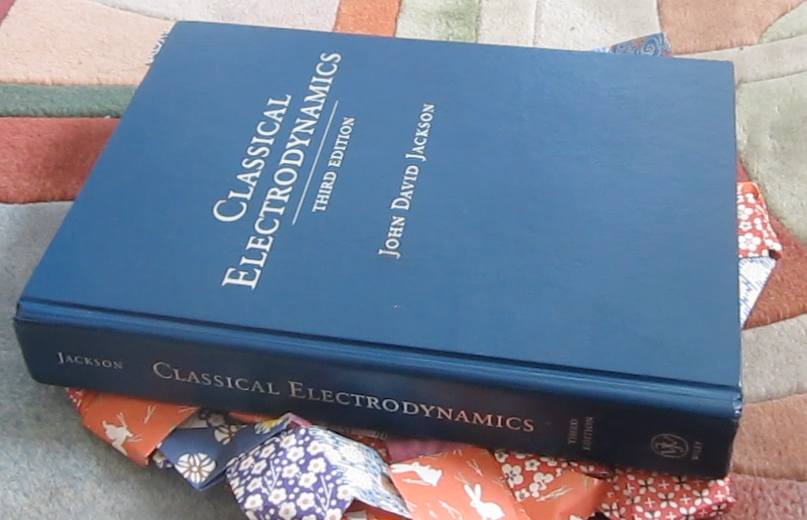
Jackson reveals yet another practical application

I chose a simple method of destruction: drop a textbook on it.  I mean, I have all these textbooks nearby, it was a natural idea.

Modern origami art

The destruction of origami is the destruction of meaning.  Here, we have so many squares of paper.  Here, they are shaped into avatars of symmetry, by fingers and planning and imagination.  And here, they become a so many pieces of paper again.  Here, they go into the trash, alongside discarded wrappers and tissue paper.  Not only does it no longer have any meaning, it never had any meaning, and was never even an "it".

The destruction of meaning is deeply meaningful to me.  I have a personal association between sentimentalism and a kind of mindless materialism.  Hoarding material objects with non-material significance.  When the objects are finally gone, their meanings, and we, are set free.

Sunday, April 20, 2014

Triply-linked cubes

Triply-linked cubes

This one is simple, yet so elegant.  There are three standard open cubes, and they're all linked together.  I got this idea from someone offline, and I thought it must be a classic modular origami design, but I can't find anything like it on the web.

The windows on each face of each cube are exactly half the length of the cube's total face.  Therefore, each cube has room to link with two other cubes, making for a three-cube maximum.  In the link above, there's a picture of fourteen linked cubes, but the fourteen cubes are linked in a chain fashion.  In this triply-linked design, each pair of cubes is linked, including white to black.

ETA: I have since found some examples of this model on the internet.  Here's one on Flickr.

Friday, March 21, 2014

TUVWXYZ Hexagons

TUVWXYZ Hexagons, by Meenakshi Mukerji

Some time back, I posted the WXYZ model, which consists of four intersecting planes.  Following the invention of the WXYZ, origami masters created so-called "planar models" with more and more intersecting planes.  This one is an intersection of 7 planes.  Each plane consists of 6 units, for a total of 42 units.

While you can make four planes intersect in a symmetric manner, you might not expect 7 planes to intersect very gracefully.  Here's a diagram showing how they go together (from here):


Each color represents a single plane.  The diagram on the left shows what's above the black plane, while the diagram on the right shows what's below the black plane.  It turns out that the symmetry group is that of a tetrahedron--note that there are exactly four hexagons.  This is actually better than you can do with, say, 8 or 9 planes (but worse than you can do with 10!).

Another thing to notice is that these are not, strictly speaking, planes.  Notice that the diagram on the left is smaller than the diagram on the right.  All the "planes" intersect at the center of the model, so you'd expect there to be an equal amount on either side of each "plane".  They are simply approximations of planes.  Isn't that funny?

There's got to be some interesting math behind which numbers of planes allow for symmetric planar models.  But it's completely beyond me.