Showing posts with label games. Show all posts

Sunday, June 21, 2015

Nintendo as cultural import

Tauriq Moosa had a good article on people of color in video games.  The article kicks off with a discussion of Rust, a western game which recently added POC to its previously all-white population.  In a simulation of reality, each player is stuck with one race forever, with no way to change it, not even by restarting your character.  I'm marveling at the sheer artistic brilliance of that idea.

You can read that article, but I'm going to go in a different direction.  As is typical of discussions of race in video games, there is a lot of focus on dark-skinned POC in western "realistic" games.  While this is certainly a worthwhile topic, it doesn't really address my experience as an east-Asian American who mostly plays Nintendo.

Japanese video games are fascinating, because they're possibly the most significant foreign cultural import to the US.  We here in the US are used to exporting our culture to the rest of the world, and experiencing Japanese imports is the closest thing to knowing what it feels like for other people in the world.

As I said, this topic is fascinating, but I also don't know what to say about it.  I am no student of Japanese culture, and I don't really understand which aspects of Japanese media are informed by Japanese culture.  There's something significant there, but I don't know what it is.  Is... is this perhaps what it's like for the rest of the world to experience US culture?  Hell if I know.

Indeed, it seems that most people in the US simply ignore the Japanese-ness of these video games.  The most obvious marker of a foreign culture tends to be the portrayal of non-white characters.  However:
  1. Most Nintendo games have cartoony aesthetics, and often no humans at all.  Compared to the "historical accuracy" excuse, this is a much more plausible reason to not portray different ethnicities.
  2. Japan, being colonized by the US after WWII, tends to portray a lot of white people, and otherwise admire white characteristics.
  3. Even when Japanese games portray characters that they think of as Japanese, Americans think of them as white anyway.  It doesn't help that Japanese people portray themselves with all sorts of hair colors.
For example, is Link white?  He may have blonde hair and blue eyes, but I think he's Japanese.  His facial features are Japanese, though they're not as exaggerated as they would be when Americans try to portray someone as distinctly Japanese.  He also obviously falls into the bishonen boy archetype, which Americans just interpret as androgyny.

Rinku: sooo Japanese.

Of course, officially, Link is Hylian, and he lives in a world with Gorons, Zoras, and, ummmm, the Gerudos.....

A race of dark-skinned thieves, not racist at all, Nintendo.  From ZeldaWiki.

I also think the preoccupation with cartoony aesthetics might be peculiarly Japanese?  But nobody seems to talk about that.

So given the Japanese influence on video games, you'd think we'd see a lot of East-Asian representation in video games.  And we do, more so than TV or movies or books.  But it's less representation than you might think because most characters are indeterminate, or appear white to American audiences.

Instead of character representation, I think we mostly get a lot of Japanese cultural influence.  But I don't recognize or understand the cultural influence, and as an Asian American it's not my culture in any case.

Friday, May 29, 2015

Risk in finance and in board games

I find it endlessly fascinating how risk is treated differently in finance, and in board games.

In finance, investments with higher risk usually also have higher average payoffs.  This indicates that risk has negative value which offsets the higher payoffs.  This makes sense, because after all, we like our security.  If you want to mitigate your risk, you can buy insurance, but note that insurance has a negative average payoff; insurance companies still need to make money.

In board games, risk may have positive value.  For the record, I'm thinking of the game I play most often, Dominion, but it works for any board game that has a blend of chance and decision-making, and which has an ongoing score to keep track of who is winning.  That's because in a board game, you don't really care about your average score.  You care about your likelihood of winning.

In a game, if you take a big risk and lose big, then all that happens is you lose until the next game.  If you take a risk and win big, then you beat out your opponent and win the game.  Flipping a coin to determine whether you win or not doesn't seem like a good deal at first, because at most it gives you even chances.  But the key point is that if you are already behind in the game, then you had less than even chances to begin with.

If you're losing, risk has positive value because it evens out your chances.  If you're winning, risk has negative value also because it evens out your chances.

If you're already winning, you want to play conservatively, and you might even sacrifice some of your average score to play safer (just like in finance).  If you're already losing, you want to play riskily, and you might even sacrifice some of your average score to increase your risk.

There is a slight complication that many people often care about their average score rather than their win percentage.  Even if you lost the game, having a higher score indicates that it was a "close game".  And if you have a very low score, that might indicate that you played poorly, not that you took a big risk and happened to lose.  So even in a board game, what counts as "good play" can be subjective, as some people value high scores while other people value winning.

Tying back to finance, for some one-percenters, it's not the money that matters (since they already have enough to live well), but how much status and power they have relative to other elites.  So perhaps there is also a realm in finance where "winning" is what matters the most.

Monday, February 23, 2015

Geek cultural hegemony

In the past few weeks, I've been referring to various nerd/geek narratives.  There's the narrative that nerds are socially awkward,  particularly around women.  There's the narrative of being the smart person in your social group.  And there's the narrative of having very geeky niche interests.

There are certain advantages to having "popular" interests.  You have a much easier time finding other people who want to talk about your interests.  A lot more money is devoted to developing products related to your interests.  If you like popular music, you can expect it to be played in retail outlets and nightclubs.  So on and so forth.

What are "geek" interests?  There isn't any precise definition, but we have a wide array of prototypes.  There's sci-fi.  Fantasy.  Anime.  Trading card games.  Dungeons and Dragons.  Video games.  Comic books.  Science.

At some earlier point in time, all of these things were niche interests, primarily loved by geek subcultures.  However, "geek" does not necessarily imply "niche", and so they may persist in being geeky, even if they do not persist in being niche.  In fact, it seems like several of the prototypes I listed are now quite popular.


Blockbuster films have very high budgets, and must be supported by a very popular consumer base.  The infographic on the right is a list of upcoming comic book movies from IO9.  I also show GTAV, one of the best-selling video games of all time, and also one of the most expensive.

If something like Lord of the Rings has vastly more cultural currency than it once did, you might guess that most of the new fans are no longer from the geek subculture.  But so what?  That's what cultural hegemony is.  Even people who are not part of your subculture now feel compelled to recognize the value of your subculture's interests.  Your interests are now popular, and you gain all the associated advantages.  Good for you.

If I sound unsympathetic, it's probably because my biggest geeky interests have not attained a similar degree of popularity.  I'm mostly a math geek.  I like game theory, set theory, real analysis, origami, and logic puzzles.  I have been incidentally interested in sci-fi, but I've never been particularly enthusiastic about it.

From SMBC

One of the antitheses of geek culture is football culture.*  Stereotypically, geeks dislike football, which is fair enough.  Football is injurious to its players, a waste public resources, and most unforgivable of all, incredibly boring.  But most things that have cultural hegemony are obnoxious when they don't personally interest you. 

*That's American football, to all the non-US people.

Maybe it's just because I talk to more geeks than sports fans, but I personally think sci-fi fans are far more obnoxious than football fans.  I can't count the number of times I've been told that I absolutely must see Star Wars, and must read Lord of the Rings or Dune or whatever.  I'm kind of reactionary about it.  I tell people that I actively dislike the "classics".  (Since I'm ace, I privately draw a comparison between the cultural dominance of sci-fi and the cultural dominance of sex.)
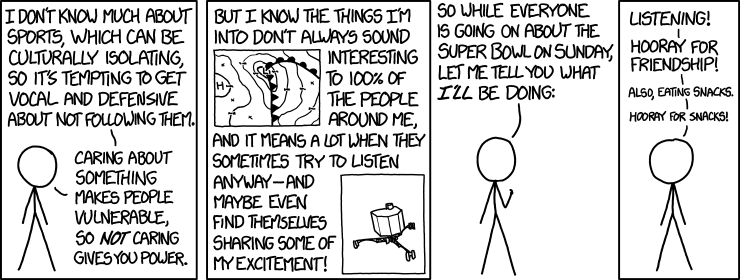
http://xkcd.com/1480/
Click for bigger original, from XKCD.  My reaction to this comic was that I'd prefer it if people were neither obligated to listen to football, nor to geeky interests they don't care about.  For instance, my dear readers are never forced to read every part of my blog.

Perhaps one of the worst examples of geek cultural hegemony is in video games.  Because the video game market has space for relatively few big-budget games, geeks are incredibly possessive of the medium.  Something like two thirds of US households play video games, and yet geeks complain endlessly that it doesn't count because they aren't the right kinds of video games (because they're casual, or indie, or Call of Duty, or sports games, or Nintendo).  This amounts to having cultural hegemony, and yet still complaining that it's not nearly enough.

Geeks are frequently defined by their opposition to popular culture and appreciation of more niche cultures.  But now that geeks are taking over popular culture, the question is, have geeks learned anything whatsoever about how to be popular without being an asshole about it?

Tuesday, February 17, 2015

Board game metaphors

Sometimes I wish board games had more cultural currency, because then I could use them in analogies and metaphors.  Alas, board games are such a niche interest that they can't really be used as a common cultural touchstone.  In fact, culture has such a "long tail" that only the most popular works can ever be used as a touchstone.  You have your footballs, your Star Warses, and your Bibles, all of which derive value from their popularity, even if their intrinsic value is in my opinion questionable.

Well, I'm just going to ramble about board games regardless of whether anyone "gets" it.

Even within board games, there are a few giants which all people are familiar with.  There's Chess, Poker, Monopoly, Risk, Scrabble.  And among nerdier people, everyone knows about D&D, Magic: The Gathering, and Settlers of Catan.  All of which I have complaints about, although some more than others.  By far the worst is Monopoly, which comes from an era when I think people just didn't understand game design.

I mostly play games in the Eurogame tradition, which is the one that includes Settlers of Catan.  I might as well say that one of my favorite games is Dominion, a deck-building game from 2008.  Dominion reached such popularity that it has been subject to a lot of imitation, and that's basically what the "deck-building" genre is.  I play several other deck-building games as well, like Ascension and Eminent Domain.

One of the interesting design choices in Dominion is the near-complete elimination of "politics".  In board games, "politics" refers to situations which depend on the power dynamics of the players.  A typical political situation is if I have a card that hurts one other player, but I can choose which player to hurt.  In Dominion, it is generally not possible to single out any opponent to hurt.  In a game like Settlers of Catan, players trade goods with each other, which is inherently political.

Because there aren't any politics, Dominion ends up being more of a pure game of economic development.  Each player has their own deck of cards, and they buy new cards to put into the deck.  Most cards improve your deck, allowing you to buy even better cards to put into it.  But you also want to buy "victory" cards, which actually make your deck worse.  When the game ends, you count up the points on your victory cards, and the highest score wins.  So the basic strategy is that you progressively improve your deck until a critical point, when you start "greening" and buying lots of victory cards (which are colored green).  The most important part of playing well is knowing when to green.

The build-up/cash-out structure is shared by many other Eurogames, even ones that are not deck-building games.  For example, in Race For the Galaxy, each player expands their galactic empire.  However, halfway through the game, some players might choose to switch to a "consume" strategy, where they take the empire they have, and focus on making lots of victory points.  Victory points don't help you expand your empire at all, but they are, after all, what's used to determine victory.

What's this a metaphor for?  Man, I don't know.  Life.  Except that life is political.

Here's another metaphor.  In Dominion, there are ways to remove cards from your own deck.  Beginners often don't understand why this is useful.  I bought those cards, why would I want to get rid of them?  Turns out getting rid of cards is one of the most powerful abilities, because it's the average card in your deck which matters.

That right there, that's a metaphor for life.  Life is like a deck of cards, and sometimes you want to get rid of some cards.  And sometimes you want to go for the village/smithy engine or the duchy rush strategy or the double jack strategy, or maybe the metaphor is breaking down here...

I don't know where I'm going with this.  Do any of my readers play board games?

Thursday, October 23, 2014

On asexuality, atheism, and other news

On The Asexual Agenda, I have a post talking about how asexuals are impacted by the current split in the atheist community.  Note that The Asexual Agenda has a much stricter comment policy than I do here, so if you want to comment freely, do so here.  I'm not obligated to respect you though.

In the years since 2011, it's become increasingly obvious that the atheist community has become more ace-friendly in the feminist communities, and less ace-friendly elsewhere.  This is good for people like me, who mostly follow the feminist atheists.  But the median person in the ace community is a non-religious woman who does not participate in the atheist community, and I suspect they mostly have negative encounters with anti-feminist atheists, or even MRA atheists.  I think aces mostly don't know where it's coming from, so the purpose of my post is to explain it to that audience.

Speaking of feminist wars, I feel like in the last month or so, the atheist feminist wars have been eclipsed by the gaming feminist wars.  That is, by Gamergate, which is probably the reason I've been blogging about social justice so much lately.  Gamergate looks very similar to Elevatorgate, albeit on a larger scale, even getting major media attention.  Furthermore, it's been noted that there's overlap between gamergate supporters and slymepitters.  To long-time atheist bloggers like me, it feels like deja vu.

I'm not so much concerned about gamergate itself, which I hope will die after so much negative news coverage.  The harassment campaigns are a serious problem, but I'm more concerned about the greater number of people sympathize with gamergate's supposed "journalistic ethics" platform, which really consists of ending "SJW" bias.  I'm more concerned about the gaming culture which spawned this movement in the first place.  I'm concerned about the impact these people have on wider society, even when they're not talking about games.

In other news, next week I will be traveling.  So I'm declaring a blogging break.

Tuesday, September 30, 2014

Arguments are about power

I can think of a few arguments that aren't about power.  For instance, when I was on the internet in high school, the things I argued about were whether 2.9999... = 3, and what happens when you put an infinite number of marbles in an urn.  I feel confident in saying that those arguments had nothing to do with power.  (Although, it should be noted that I eventually earned a modder position on that website, and helped control content.)

But a lot of arguments are really about power, especially the loudest and most volatile arguments.  That's often why they're so loud and volatile.  And when I say that the argument is really about power, that doesn't merely mean arguing about who has power, or who deserves power.  The argument itself is part of the power struggle.  Winning the argument materially gives you more power, independent of whether you won by being on the right side.

I admit this is a very cynical view.  Nobody on either side of an argument wants to say that it's really about something so crass and selfish as power.  Better to pretend that the argument is about what's true and righteous.  But if you actually care about what's true, it's clear that arguments are often not about what's true.  And we need to realize that power struggles are not necessarily bad, and that we're participating in power struggles all the time.  It is not wrong to want power, or to want someone else not to have power.  Although it can be wrong, depending on how you get what you want.

Some of the clearest examples are arguments over video games.  Many recent high-profile incidents  show how nasty video game culture can be, but that much has long been obvious to anyone who paid attention to gaming communities.  This is easily explained by an underlying power struggle.  As I said last year, there is a limited space for games in the market, because they're so expensive to develop and advertise.  In particular, this is true of so-called AAA games, which are the big-budget games we usually think of as being "hard-core".  Everyone needs to choose from the same small set of games, so the power struggle is over what games get made, what games get the money.

There's an image that shows up repeatedly in these arguments, the white male gamer who is afraid of other people stealing his hobby.  For example:
It’s hard for them to hear they don’t own anything, anymore, that they aren’t the world’s most special-est consumer demographic, that they have to share.
This is treated as a caricature, something pathetic and laughable.  But I think it's also true, gamers really are afraid of sharing space.  And furthermore, they are right to be afraid, because sharing may in fact result in diminished space for themselves.  If more AAA gamers are convinced that games need to represent women better, then everyone will be forced to play AAA games with better female representation, if they play AAA games at all. Those poor sexist gamers.  In losing the argument, they really are losing power.  Although maybe not as much power as they think.  I'm sure they will continue to be able to find some games that appeal to them.  And perhaps having more women will just mean that more games will be made.

The power struggle among gamers comes from control over the public good of video games.  Another public good I often concern myself with are identity labels.  Arguments over labels are also frequently arguments about power.  Who gets to control what a label means?  Who controls the public image?  Who controls the actions of any organizations arising from the label?

All the big wars over feminism in the atheist movement?  Those are clearly about power.  Power over who speaks, power over who makes up the movement, and power over what the movement focuses on.

When people harass Jen McCreight or Rebecca Watson to get them to shut up, that's about power.  When Jen McCreight invented Atheism+, that was creating a space where social justice is legitimate atheist cause, and that was about power.  When people mock FTB as "FTBullies", they're discouraging people from looking at FTB, and that's about power.  When people on FTB mock "brave heroes" and "freeze peach", or talk about how Skeptic Ink was founded on hating FTB, that's about power.  When Dawkins refers to PZ Myers as writing clickbait, and using it as an excuse to not link to PZ, that's about power.  And when you say that you're above all that nasty stuff, well, that's about power too.  Everything is about power, get used to it.

That's not to say that there aren't also arguments about truth in there.  Some groups don't use their power as well as other groups, and that's a truth we can argue over.  Anti-harassment policies at conferences seem like an obvious good to me, and the people who would use their power to remove them are basically incompetent leaders.  And by winning this argument, we take their power away.

But we can also take their power away by name-calling.  That's the truth.  And while I'm hardly a name-caller myself, it seems like you have to accept the tactic, lest you just forfeit the struggle.  But how is name-calling different from harassment campaigns, which we also know go both ways?  Do we have to accept harassment campaigns too?  I don't.

It's a rationalist fantasy that if we just all argue rationally and carefully work out the details, we'll agree on the conclusion and rid ourselves of conflict.  A good rationalist recognizes how small a role rationality really plays in the biggest arguments.

Thursday, September 18, 2014

I support games criticism

How many people here have heard of #gamergate?  At first, all I heard was that it was a harrassment campaign against indie game developer Zoe Quinn, who made Depression Quest.  Apparently over something really petty, like her ex-boyfriend accused her of sleeping with a reviewer.  I didn't really read into it, because I think I've already seen enough harassment campaigns against women on the internet, and I already know it's not pretty.

But I did eventually read more about it, because I follow Giant Bomb's linkspam.  Apparently, there are some supporters of #gamergate who think that gamergate is more than just harassing women.  To them, it's about "corruption" in the games industry and games journalism.  It's about social justice bias.  It's about journalists getting too chummy with games developers.  It's about journalists failing to be utterly objective about reviewing games.  It's totally not about harassment, that's just a small minority, they say.

This deserves some major concern trolling.  Don't they realize that the entire image of their movement is dominated by the harassment campaigns?  Maybe they should be uniting under a different banner?

But even putting aside anything about harassment, the "gamergate" cause is deeply misguided.  This can be illustrated with an op-ed written by Jenn Frank about Zoe Quinn and Anita Sarkeesian.  Look at the footnote:
• The following footnote was appended on 5 September 2014: An earlier footnote, appended on 1 September, made clear that Jenn Frank had purchased and is a supporter of ZoĆ« Quinn’s work, although this is the first article she has written on the developer and that Frank has also briefly met Anita Sarkeesian. These facts had been included as a footnote by Jenn Frank when she filed her copy before publication but removed by editors because they did not fulfil the criteria for a “significant connection” in line with the Guardian’s editorial guidelines. However, the Guardian wishes to make clear that it was an editorial decision originally to remove the original disclosure, not one made by the author, and we are happy to have restored it in the interests of full disclosure.
There's a story behind this footnote.  Jenn Frank had added in a footnote disclosing her relationship with Zoe Quinn and Anita Sarkeesian.  The Guardian decided that this wasn't relevant to include, probably because the relationship is so tenuous as to be irrelevant, and plus it's an op-ed.  An op-ed is supposed to be biased, and supposed to express personal opinions.  But gamers found out about it, and demanded* disclosure, in the name of journalistic standards.  Apparently, #gamergate thinks it has a better idea of journalism than the Guardian, and their idea involves "objective" op-ed pieces with entirely irrelevant disclosures.

*The demands were backed up by a harassment campaign, which caused Jenn Frank to quit games journalism entirely.

Despite wanting games journalism to move forward, people are demanding that games journalism move backwards.  They want it to be a glorified buyer's guide.  Gaming is a hobby that really requires a buyer's guide because there's a big upfront cost and large time investment.  But is that really all gamers want? 

It's worth understanding the distinction between game reviews and game criticism.  Game reviews express opinions (yes, subjective opinions) on games, with the intent of informing buyers.  Game criticism also expresses opinions on games, but with the intent of considering wider cultural implications (or at least wider game implications).

For me, games criticism is the main reason I pay attention to gaming news.  Criticizing and understand games is a lot of what makes them fun.  I want to understand the design elements, the constraints imposed by the game industry, the structure of game narratives, the representation of women, and so on.  Basically, I like to talk about games, in addition to playing them.  And I'm convinced that all these vocal gamers on the internet... they must like talking about games too, or they would be playing them instead of mounting misplaced campaigns.

The other half of it is that games criticism is why I play games.  I had stopped for a number of years, but when Anita Sarkeesian started producing her videos, I got more enthusiastic again, and bought my very first home console (the first one since I've become financially independent).

One of the things #gamergate was outraged about, was an article declaring that "gamers are over".  People saw it as an attack on gamer culture.  And to be honest, I think the attack is entirely deserved, considering the legacy that gamers have produced.  We're literally talking gaming terrorists!  And while that's obviously coming from some small minority, you don't have to look very far in the comments to find people who think this counts as Anita Sarkeesian "playing the victim".

But that's just an "attack" in the sense that a criticism is an attack.  Now, the discouragement of games criticism, that's a real attack on gamer culture.  Without people talking about games and what they mean, what is left of gamer culture?  I think there would be nothing left for me.

Friday, May 9, 2014

Nintendo nooooo

In video game news, Nintendo will soon release Tomodachi Life in North America and Europe.  It's a "whimsical life simulation" which allows you to import avatars of you and all your friends and watch them have wacky adventures, including romantic pairings and marriage.

This is significant because it forces Nintendo to take a stance, to either include same-sex relationships in the game, or not to include them.  I'm not sure when this last happened to Nintendo.  They don't make an awful lot of life simulations.

Unfortunately, Nintendo appears to be taking the wrong side.  There was a "Miiquality" campaign to let Nintendo know how much we want this feature, but Nintendo issued a tone-deaf response, saying they "never intended to make any form of social commentary", and that it "was not part of the original game that launched in Japan".

I seriously considered buying Tomodachi Life, because I like Animal Crossing: New Leaf.  But whatever desire I had before, the lack of same-sex relationships kind of kills it.  Not because I want to boycott it to make a political statement (there's blogging for that), but because it would honestly give me less enjoyment.  It would be very jarring and uncomfortable to see all these alternate versions of myself and my friends, all forming male-female pairings.  I and many of my friends are queer!

For many queer people, heterosexual relationships were the kind of thing forcefully pushed upon us by unsupportive parents and grandparents.  And now this game is pushing it too?  Nope, not gonna play that.

In the comments of Polygon and Kotaku, many players mount defenses of Nintendo, saying that they have to pay attention to the bottom line, and make the game that players will want.  I find this to be strange argument.  Yes, it is true that Nintendo does not deserve exclusive blame for making exclusionary games.  Some of that blame belongs to consumers, who either prefer or tolerate exclusionary games.  In the Japanese version of Tomodachi Life, I mostly blame the Japanese consumers.  In the rest of the world, I blame consumers as well as the Nintendo localization teams.

But wait, aren't the people making this argument themselves consumers?  Are they trying to shoulder the blame themselves??

I mean, who exactly do they think these consumers are, who are stopping same-sex relationships from appearing in games, movies, and fiction in general?  It's very convenient to think that the blame belongs to such conservative groups as Focus on the Family and Million Moms.  But when I look around the gaming community, it's much more common to see people who argue, "Don't blame the game creators, they can't do any better in this market!"

People think they know what heterosexism and sexism looks like, but they're wrong.  It's not an angry gang beating people up in the street (at least, it isn't only).  It's a million people shrugging their shoulders saying, stop complaining, nothing can be done.

Update: Later, Nintendo had a highly positive response.

Thursday, November 28, 2013

Why video games are so flammable

With Black Friday upon us, the flame wars over next-gen gaming consoles have really been heating up.  Which will win: the Wii U, XBox One, or PlayStation 4?  No one truly knows, but gamers everywhere agree that everyone else is wrong and should feel bad about being so stupid.

While I don't intend to make a habit out of discussing economics, I do think that video game flame wars can be understood within economics.  The problem is twofold:
  1. There is limited space for video games and video game consoles, and everyone knows it.
  2. Video games are in a state of monopolistic competition.
Video game producers are most efficient when they make fewer, larger games, for many reasons.  Developing a game is a one-time cost, while actually manufacturing the game is cheap.  Selling more copies of a game is not a matter of paying for more manufacture, but paying for better advertisement and development so that more people want to play.1  Note that it's much easier to advertise one big game than to advertise many little ones.  The main reason to have more smaller games is to better cater to different tastes (e.g. see the indie game industry).

Video game console producers have even more reason to be large.  Besides the large development costs of video game consoles, gamers also want consoles with games on them (especially games exclusive to that platform).  Consoles won't get many games unless there are many consoles to go around.  Whenever game developers port a game to a console, or make a console-exclusive game, their market is restricted by the number of console owners out there.2

The important number here is the ratio of the optimal size of the video game industry to the optimal size of a video game or video game console.  For consoles, that number appears to be 3-5.  For games, it's much larger, but still noticeably discrete if you focus on major companies.

The second problem is that video games are in a state of monopolistic competition.  That means that the products of different companies are all different, and are not perfect substitutes for one another.  Thus different consumers might have different preferences.

This puts consumers in a sort of Battle of the Sexes game.  The best outcome to a consumer is if they buy the games and consoles they want, and everyone else follows even if it's not what they most want.  But if everyone buys something else, the consumer has to choose between buying what they want (even though a worse-selling product will suffer in value) and buying what everyone else is buying.  People don't like being in this situation, and it's clear whose fault it is: other consumers!  Flaming those people may vent anger, and also persuade more consumers to one's own side.

There are, of course, other causes as well.  Video game consumers are particularly well-informed.  Also I think people just like flame wars.

It will be interesting to see how the games industry changes over time.  Development and advertisement costs may go down.  The market may expand to include a wider array of consumer tastes.  Porting games between platforms may get easier.  How will this affect the number and size of video games?

------------------------------------------------

1. In a list of the most expensive video games, older games spent a lot on manufacturing, but more recent ones spend on development and advertising.   For example, GTA V (2013) spent 51% of its budget on development,, 45% on advertising, and only 3% on manufacturing.
2. Any smaller consoles face these difficult problems.  This is why people often mock consoles like the Ouya or Mojo.

Monday, November 11, 2013

Thoughts on gamer shame

When I went to the Queerness in Gaming Conference, a couple speakers made an analogy between the shame people feel for being queer, and the shame they feel for spending too much time playing video games.

This analogy is sort of a rhetorical trick.  Everyone in the audience already considers queer shame to be mostly bad or unjustified, and the analogy frames the conversation such that we automatically think gamer shame must be equally bad or unjustified.  Nonetheless, I find it to be a good analogy, because it draws "gamer shame" to our attention, and gets us to think critically about it.

Upon reflection, gamer shame is something that has long been present in my life, without me really thinking about it.  I think it's the way I was brought up: my parents always tried to put a limit on how much games me and my brothers played.  Now I replicate those same attitudes towards myself, and towards my boyfriend as well.  Not without my boyfriend's permission of course--he knows he lacks a bit of self control, and that social encouragement is helpful to him.

Gamer shame also comes with a stereotype: the unhygienic middle aged man who still lives in his parents' basement, and plays WoW all day and night.  The speakers made the interesting observation that when people try to show the positive face of gaming, they usually show people playing with friends on a couch.  This image says, "Gaming is a social activity for socially functional human beings."  It's as if gaming is only acceptable when it's on-the-couch multiplayer, and any form of solo gaming is unacceptable.  We can draw a comparison to the way the image used to advocate gay rights is white gender-conforming men in long-term monogamous relationships.

I happen to like on-the-couch multiplayer games a lot, since that's what I would always play with my brothers growing up.  But it's not as if I don't also play games solo.  The fact that one is more socially acceptable than the other seems ridiculous.  Most other media are also consumed alone.  We read books alone.  We listen to music alone.  We watch TV alone.  Movies are often thought of as a social outing, but it's not as if people interact with each other much while they're in a theater.

In general, I think it is good to think of gaming as just another medium.  Spending time on video games is no less worthwhile than reading a novel or watching a movie.

At the same time, gaming is a very unique medium (as all media are unique).  One thing that's very different about video games from other media is that length is usually a selling point.  By contrast, when's the last time a movie was ever advertised as being very long?  I think this is because video gaming often serves the function of killing time, and serves it well.  Video games are usually built to be engaging, compelling, or hard to quit.  This is a great thing, but can also lead to conflicts between what someone wants in the long term and in the short term.  I don't know that "gamer shame" is justified, but surely "gamer self-control" has its uses.

Wednesday, October 30, 2013

Queerness and progressive game design

Earlier, I attended a conference on queer theory, game studies, and game design.  This inspired in me several topic ideas.  I will start with the one that is most directly related, and most reactionary.  One of the conference's major themes was how to find queerness in games beyond the literal inclusion of queer characters.  Queerness isn't just in the characters, it's in the image of gamers, in the broader narrative themes, in the way we play games, and in the design and mechanics.

There are many great ideas in there.  But some ideas... Well, they're "productive" ideas in the sense that it's helpful to discuss them, but they're ultimately bad ideas IMO.  In particular, several conference speakers decided that queerness in games can mean conforming to their particular ideas about progressive (and transgressive) game design.

For example, it was repeated many times that queerness means choices in your video games.  Queerness means transgressing the prescriptive definitions of a "game" made by formalists.  Queerness is playing a game and making your own objective rather than using the one designated by the designer.  One presenter even said queerness means fluidity in the rules of the game (this being the context of tabletop RPGs).

The overall message I seem to be getting is that queerness is Indie.  Which maybe sounds just a little too much like self-flattery when it's coming from a bunch of queer indie game designers and queer indie game lovers.

Don't get me wrong, I love indie games.  These days I've been playing more AAA games, but indie games are often the ones pushing the envelope, ultimately resulting in a better future for all games.  But though queerness is great and progressive game design is great, they don't really seem to be the same thing.

If queerness is reduced to themes of human variance, fluidity, and transgressing norms, then you'll find these themes everywhere you want to find them.  (You'll find these themes in AAA games too, but I think people at this conference were less interested in finding them there.  It was said during the conference that buying AAA games is supporting capitalism, but we shouldn't shame people who do it because maybe they just don't have the cultural capital to really be aware of the indie games out there.)  And yes this is a problem.

It's sort of like... Dumbledore being gay in Harry Potter.  Author J. K. Rowling said that Dumbledore was gay, but it's not really clear from the books themselves.  So the bottom line is that this queer "representation" may not be satisfactory to many queer readers.  Therefore, it's best not to overplay the queerness of Dumbledore, because frankly we can do better than that.  Similarly, it's best not to overplay the queerness in games, because many queer people are not going to be satisfied just by progressive game design, and we can do much better than that.

I can also imagine other problems with equating queerness and indie gaming.  Imagine a queer person feeling that their queer cred is under question because they are disinterested in indie games.  I don't think this is a likely scenario, but it could be likely if the queer indie ideology at this conference were widespread.  It's even more problematic to say that fluid game rules are queer, because even when it comes to sexuality, queer does not necessarily mean fluid.  Plenty of trans people felt they were always the gender that they are, and plenty of bi people do not feel that their orientation fluctuates from gay to straight (which is a common misconception about bi people).

If progressive game design means bucking some common sexist, racist, cissexist, or heterosexist conventions, then sure, that's more queer.  It would be great to come up with new fantasy races, rather than the rather racist ones inherited from Tolkien.  It would be great to have some new mechanics which make it easier to tell stories about groups in relation to society (rather than the usual stories about a single straight white male hero).  It would be great to offer the player more choices about character genders (ie more than two) and sexualities.  New ideas in narrative and game design are essential to improving the experience of queer players, but progressive game design in itself is not sufficient.

Sunday, October 27, 2013

Conference report: queerness in gaming

Not the target audience

I attended the Queerness in Gaming Conference (QGCon) this weekend.  It was a unique intersection of topics: game design, the academic study of games as a medium, and queer theory.

I was not really in the target audience for this conference, since I neither design games, nor work in a remotely related academic field.  I am a mere consumer of games.  Probably a conference like GaymerX would have been more appropriate for me.  But even though I was not the target audience--in fact, partly because I was not the target audience--I found it to be full of ideas that were novel and fascinating.  And though I will not apply any of this knowledge, it was thoroughly stimulating, and could enhance my enjoyment of games.

Being a typical ungrateful blogger, I will talk at length about all my disagreements with things in the conference, while glossing over the stuff I agreed with.  But one should not infer that I disliked the conference. Even listening to talks I disagree with is a joy.

In particular, there was a lot of critical theory in the conference (literary criticism, postmodernism, or whatever you'd like to call it).  In the world of skeptics, I'm relatively sympathetic to postmodernism, but that's like saying that in the world of gender studies, I'm relatively conservative.  A lot of critical theory is still nonsense to me, and this conference provided many egregious examples.  For much of this post, I may be teetering on the edge of a rant, but I'll try to save the rant for another time.

More than representation

The most striking thing about the conference is how little it discussed queer character representation in games.  Speakers uniformly believed that there are many more ways to find queerness in games.

For example, stories can have queer themes without having any queer characters.  Jack Halberstam talked about how once we moved from 2D animation to 3D animation, cartoons became more capable of depicting crowds, and thus featured more stories about large groups.  So you get stories about conflict between groups, which is more reflective of the conflict between queers and normative society.

Some mechanics of games were also described as queer. If players can decide for themselves the traits of their character, this allows them to express something different or unique about themselves.  Unfortunately, choices also tend to be constrained, such as to a gender binary.  Or perhaps the choices have no real impact on the game (eg, the NPCs in Skyrim will hardly react to the protagonist's race, even though there's supposed to be signficant racial tension in the world).

There are also many ways we can apply queer theory to how we play games.  Samantha Allen and Kathryn Bond Stockton both made a fascinating analogy between the way people are shamed for being queer, and the way they are shamed for being gamers.  There are also some interesting problems in the way gamers are presented in order to buck their negative image.  Namely, social gamers are emphasized, and solo gamers are deemphasized.  Another interesting parallel was between The Art of Failure and The Queer Art of Failure.  The latter book is about the way that the system of success and failure enforce cisheteronormativity by describing queerness as failure.  The former book is about how we like games even when we fail at them, much the same way we enjoy tragedies.

And there were lots more analogies; speakers really liked analogies.  Sex and gaming was a particularly common analogy.  Moral panic over kids playing games is like moral panic over kids being gay.  The power structures and role playing in games are like kink.  There was a lot of Freudian comparison of joysticks and first person shooters to penises (I think only some of this was serious, although it is my humble opinion that ironic Freudianism is no more acceptable than serious Freudianism).  One speaker compared the censorship of sexual content in imported games to the blocking of homosexual immigrants earlier in US history.

I liked speaker Adrienne Shaw, who talked about doing some ethnographic studies of gay gamers.  She found that most of them don't care so much about having character representation.  They care more about the homophobia, and the image of the white heterosexual cis male gamer.  She critiqued the idea that if we just got more gaymers together, representation would automatically follow.  Female gamers have been around for a long time, and yet the structures of exclusion have not been dismantled.  Furthermore, even if game producers did decide to cater to the queer market, this would only include the least marginalized among queers, and would not be a complete solution.

But yes, representation too

There were, of course, also lots of talks about representation.  I particularly liked talks about history.  Bill Jahnel talked about the (very problematic) history of queer representation in comic books.  Hanna Brady talked about the (also extremely problematic) representations of race in fantasy, and also had a bunch of cool book recommendations.  Evan Lauteria had a short but fascinating talk about the way early Japanese games were localized in the US.  In particular, he compared Poison from Tekken and Flea from Chronotrigger, both trans villains.

There was also lots of talk of more modern representation, from Bayonetta to Dominique Pamplemousse to Bioware.  While I enjoyed these talks, I seem not to have written many notes on them... but they were a presence!

I also enjoyed the open arcade, which was a showcase of indie games with queer themes in various forms.  It included a couple Twine games, an interactive fiction, and a puzzle platformer that told me it hated me.  Indie games, of course, are much more able to have queer themes and appeal to niche audiences.  My favorite one, of course, was the puzzle game.  Triad was a short puzzle, designed by Anna Anthropy, in which the goal was to fit three people on a bed without anyone falling off.  And I entered this conference thinking that there wasn't much opportunity for queer representation in puzzle games.

My greatest disappointment with the conference is that Anita Sarkeesian was there, but I did not even realize until after it was over!

Potential future topics

Attending QGCon, especially the parts I disagreed with, inspired in me several blogging ideas.  Most of these ideas extend beyond just this conference.  I outline them here:
  • Labels are maps, not walls
  • Can analogies be arguments?
  • Queerness and progressive game design (and why they're not the same)
  • People should bring out their disagreements rather than acting like we all agree
  • Academic queer theory vs internet queer theory
  • thoughts on gamer shame
I hope readers enjoy these topics, and I apologize for procrastinating the completion of my other two running blog series.

Monday, June 24, 2013

In praise of non-deductive puzzles

It's a convention in many logic puzzles that there is only one solution, and you reach this solution by deductive steps.  But there are a few logic puzzles that are not entirely deductive.

I hope readers don't mind that I spoiled one of Nikoli's sample puzzles.

One of the classics is Numberlink.  In Numberlink, you're supposed to draw lines between each pair of identical numbers.  There is always a unique solution, and this solution just so happens to use every square.*  But even though there is a unique solution, you're not supposed to solve the puzzles by deduction.  You have to use a lot of guessing and intuition, or it would be too difficult.  MellowMelon has a guide on how to solve them.

*If you ever download a Numberlink app for a mobile device, they often require that every square must be used, rather than having a unique solution that just so happens to use every square.  I consider this a serious travesty, and do not recommend Numberlink apps.

I would like to contrast this with a lot of puzzle apps out there which do not have unique solutions (eg see this review).  Usually this isn't because they've been designed as non-deductive puzzles, but because the programmers couldn't be bothered to check for unique solutions.  This is the worst.

This was a randomly generated puzzle from Tatham's puzzle collection.

Moving away from pencil-and-paper puzzles, there is a game called Blackbox.  It can be played with two people, but it's really better to play against a computer.  In Blackbox, there are some balls in a box, and you're supposed to figure out their positions by shooting some lasers into the box.  You can't tell what the lasers do inside the box, but you can tell where they come out, if they come out.  There's a lot of room for deduction here, though solutions aren't unique.  But it's really more fun to try to figure it out based on the smallest number of laser beams.  Since you decide where to shoot the lasers, it tastes a bit like experimental science.

You can play Blackbox within Simon Tatham's puzzle collection, which has free mobile app versions.  I also recommend Eric Solomon's hexagonal variant.


Lastly, I'll mention a card game I just bought called Hanabi.  Have you ever seen those logic puzzles where people wear colored hats, and can only see the colors that other people are wearing?  Or perhaps the puzzle of the three foolish/wise men who wake up with marker on their faces?  Hanabi is sort of like that, because each player holds their hand backwards, so that only the other players can see.  Players cooperate by giving each other hints to play the right cards in the right order.

But while the colored hats puzzles are deductive, Hanabi is not because you can't be sure that everyone is playing perfectly (and no one knows what that would even look like).  Furthermore, there's never quite enough information to play deductively!  It's a lot of fun.

In conclusion, there is plenty of interesting puzzle-space to explore beyond deduction.

Monday, June 17, 2013

In which I buy video games

I mentioned earlier that I was enthusiastic about Anita Sarkeesian's "Tropes vs Women in Video Games" series.  It inspired me to read more video gaming news, which I hadn't done since high school or so.

My first impression is that gamers are rather defensive about their medium!  They're beset on all sides.  People skapegoat video games for gun violence.  News stories hype and exaggerate game addiction.  The public is weirdly censorious about sexual themes in video games even though movies have them beat a million times over.  Publishers insert DRM into games in a way that inconveniences legal customers.  Large game companies like EA and Zynga are also evil for various reasons.

In this context, it becomes easier to understand why Anita Sarkeesian has gotten a lot of backlash from gamers.  Many people are seeing her criticisms as an attack on the medium, and Sarkeesian as yet another anti-gaming crusader.  But this view is far from true.  If you watch her videos at all, it's obvious that Sarkeesian is a gamer herself.

And Sarkeesian's criticism, far from being attack on video gaming as a medium, actually made me more enthusiastic about games!  As I said earlier, I started paying attention to video gaming news for the first time in years.  Then I thought about how much time I was wasting on low-quality games, when I could be wasting it on high-quality games instead.  I played Bioshock Infinite, which had a great story, even though it was essentially a damsel-in-distress story.  I played indie game Antichamber, which is some sort of non-euclidean puzzle game.

Then I bought a Wii U (no, it is not a modified Wii, it is the next-gen console).  That's several hundred dollars of my disposable income!  I know the Wii U hasn't been doing too hot, but I wanted those Nintendo franchises.

At the beginning of every video, Anita Sarkeesian says, "Remember that it is both possible (and even necessary) to simultaneously enjoy media while also being critical of it's more problematic or pernicious aspects."  I would go further.  Being critical of the media we consume allows us to take a more active and enjoyable part in it.

Monday, June 3, 2013

Faith in fiction is hard

My blogging rate has been suffering lately because I decided to watch most of the Extra Credits video series, mostly about video game design.  I found it quite interesting, even though I hardly play any video games anymore, and have no interest in joining the game industry.  Being a typical ungrateful blogger, I will reward the show by picking out the one video I disagreed with most so I can talk about how terrible it was.

Specifically, they try to explain why video games have thus far failed to deal with themes of faith (and not just dealing with the trappings of religion).  I do not agree with their explanation.


They got so many responses to the video that they posted another video defending themselves.

I did not read the responses, but I suspect that the main reason they got so many negative responses is that they repeated some pretty standard arguments in favor of faith.  They argue that science and math also require faith, bring up the early 20th century physics revolution, and patronizingly attribute hostility towards faith as a mere reaction against bad behavior from people of faith.  This is guaranteed to provoke a strong reaction, because lots of people have already heard these arguments, and have pre-prepared counter-arguments.

But I won't get into any of these arguments (unless any readers are interested).  Rather, I wish to discuss why video games have failed to deal with issues of faith.  Extra Credits believes that it's because the gaming community is hostile towards faith.  That's only half right.

The thing is, if the gaming community were just uniformly hostile towards faith, then it would be easy for video games to explore faith by putting faith in a negative light.  And arguably video games already do this to some extent.1  The problem is that gamers are not uniform.  If the gaming community is anything like the rest of society, there are radical atheists like me, conservatively religious people, and also the entire spectrum in-between.  Some people whole-heartedly value faith, others think faith has no value whatsoever, and still others (like the people in Extra Credits) think it's a wash.  It's really hard to make a work of fiction that deals with faith themes in a way that will satisfy people in a large range.

Usually when a writer tries to deal with faith or religion, it feels like they're beating you over the head.  If a writer makes a character who values faith, and portrays any consequences this has for the character, this already telegraphs the writer's position on the matter.  If the consumer disagrees with this position, they'll feel values dissonance2. And even if the consumer agrees with the position, they may feel uncomfortable with how heavy-handed it is.3  And it doesn't help to portray faith as partly good and partly bad, because lots of us really think it's mostly good or mostly bad.

One way to get around the problem is to only portray things that we mostly agree on.  Most people think violent religious zealotry is bad, so writers can portray that negatively without problems.  We can all agree that sometimes the ways that religious and non-religious people interact is problematic.  We can all agree that particular people who are religious or non-religious may have their personal strengths and flaws.

Another way to get around the problem is to avoid portraying positive or negative consequences.  This allows the consumers to judge it however they like.  For example, I think House did this on a regular basis.  Dr. House was very much anti-faith, but some of his doctors acted as religious foils.  Whenever an episode dealt with religious themes, viewers were free to agree with Dr. House, or to agree with any of the religious characters.  It's a difficult balance, and it's hard for me to tell if they pulled it off, since I have a one-sided perspective.

It may be particularly difficult to pull this off in video games.  Consequences are everywhere in video games.  Extra Credits suggested a faith-skepticism meter (much like the good-evil meters in many games), but this wouldn't work if the meter has any consequences with respect to achieving in-game goals.  If having a faithful or a skeptical character were both valid strategies, that would harm my suspension of disbelief.  I think the way to go is to offer the player choices that don't have in-game consequences (except perhaps who your allies are).  The consequences are simply how the player feels about playing a faithful or unfaithful character.  If I recall, Mass Effect was able to do this, but it's been years since I played it.

(Further complicating matters are the fantastical settings in many video games.  In some of these universes, it may be unreasonable to be an atheist, and faith may mean something entirely different.)

---------------------------------

1. To judge for yourself, see this Gamespot video showing lots of examples of religion in video games.
2. See TV Tropes.
3. This is why I don't like the His Dark Materials trilogy.  Though I might agree with Philip Pullman's views on religion, it felt like he was just beating up on a concept that couldn't defend itself, because the only person who could provide a defense was Pullman.

Thursday, May 30, 2013

Go Anita Sarkeesian

Anita Sarkeesian is producing a series of videos called Tropes vs Women in Video games, and this is the latest video (also see part 1). Warning: lots of violence.


A bit about the history of the project:  Anita Sarkeesian proposed it on Kickstarter, and got a lot of backlash and harrassment for it.  In the counterbacklash, the project got way overfunded ($160,000 when she asked for $6000).  As a result, it has very nice production values.  I like it a lot.

But the video also felt discomforting in a way that's difficult to express.  I've only played a few of the specific games mentioned in the video, but every single trope felt familiar.  And while there was much horrifying graphic violence, it simultaneously felt completely ordinary.  And the fact that it felt ordinary was itself sickening.  And then to see the same story lines be repeated a hundred times made it worse.  In any particular game, violence seems justified through extraordinary circumstances, but when the same "extraordinary circumstances" appear in game after game, it becomes inexcusable.

Incidentally, on Sarkeesian's blog, I found this video series Extra Credits.  The creators view video games as a medium, just like TV, movies, or literature.  They have lots of ideas on the direction of the gaming industry.

These days I play more board games than video games.  Board gaming is also male-dominated (at least in the US), because when I was younger they were marketed almost exclusively to boys.  There also used to be a lot of war games that were basically terrible.  These days a lot of board games no longer center on war or violence, but the male majority persists.

Thursday, October 9, 2008

Science in Spore

Remember the computer game Spore, which simulated the history of a species, from a tiny cell to a sentient, space-faring civilization? Of course you do. It was just released last month. So here's the deal: I'm going to briefly discuss how Spore treats evolution, science, and all the other things that skeptical evolutionists care about. Some people might complain, "It's just a game. Why do you care so much about whether the game universe realistically portrays the real universe?" To this I respond, "It's just a blog. Of course I don't think a game should be judged for how realistic it is! This is just my excuse to talk about science and pop culture."

Spore begins by completely avoiding the question of how life formed. Instead, a meteorite falls into a planet's ocean, opens up, letting the first life form out. I gotta say, panspermia is way cool. Anyways, this first life form starts out with eyes, a mouth, bilateral symmetry, and a spine, and you instantly find yourself in a 2-d environment populated predators and prey/food. It all seems very vertebrate-centric, skipping all previous evolution and ignoring alternate paths. I guess that's because single-celled organisms are ugly and boring gameplay elements. I mean, there was a cool game in The Time Warp of Dr. Brain called "Primordial Soup", but I digress. In Spore, your creature evolves in leaps and bounds, as a mere representation of the real process. Every time you mate (G-rated mating, naturally), you're given the choice to change around the morphology of your creature. You know, add a spiky thing here, an electric protrusion there, like legos!

Two problems: The overly progressionistic portrayal of evolution is not exactly right, but then what kind of game would it be where you didn't progress? You might also protest, "Isn't this more like Intelligent Design than evolution?" Yes, but it would be kind of boring if you didn't get to decide how your creature would evolve, wouldn't it? Well, natural selection simulators like this one or that one are Fun Times, but again I digress. Point is, a natural selection simulator would be a whole different game, not Spore at all.

Eventually, after about half an hour real-time or several billion years game-time, your creature progresses to where it can evolve legs and walk on land. In one of the game's more realistic moments, all of your creature's old body parts gain different functions on land. That electric protrusion? It doesn't work on land, so now it's used to give your creature the ability to "charm". This happens all the time in evolution, so I think it's sweet that they had it in the game. That is, the changing of functions is sweet, not the "charm" thing. I have no idea what the "charm" action corresponds to in the real world (it is used to charm other species, not your mate).

On land, evolution continues representationally. However! Now, not only can we forget about natural selection of any kind, we also no longer have any sort of emergent fitness. In the 2-d water environment, placing the spiky thing on the front would make you more offensive, while placing it in the back would allow it to poke pursuants. On land, it doesn't really matter where you put your spiky things, as long as they're somewhere on your creature. For example, if you've got a spur-shaped appendage, it doesn't make a difference whether you place it on your arms, where it might be handy, or if you place it on your back, where its use appears impossible. Apparently, early in the Spore's game design, they intended to have fitness emerge from the morphology of the creature, but they just couldn't pull it off. Play-testers felt that their creativity was limited by this mysterious formula which determined speed and other fitness. Eventually, they decided that the player should be able to design their creature in whatever way most pleases them, with relatively little effect on fitness (source: this interview). That's too bad, because emergent fitness is a very fascinating gameplay element (also more realistic, and necessary for evolution, if anyone cares to know). But who are we to question the omniscient game designers? They are gods' gods.

One of the elements in the game is a sort of sliding scale between a more social species and a more aggressive species. You can move back and forth between the two strategies, and your decisions will show up on this cool timeline of your species' history. At first, this is affected by whether you eat plants or meat. Later, it depends on whether you befriend other creatures or if you attack them. Even later, when your species starts a civilization, you can choose between a religious, economic, or military strategy. Supposedly, this made some "militant atheists" angry, but I'm not sure I believe in the existence of such people. I played once as a religious civilization, and I thought it was hilarious. A militaristic civilization attacks and conquers other cities. An economic civilization buys out other cities. A religious civilization creates giant holograms above the city to convert them. They also shoot conversion rays. They are colorful and musical?

On the subject of religion, when your species becomes a space-faring civilization, it gains a unique identity based on its entire history. You can become a Zealot, a sort of militaristic/religious combo, or a Shaman, a more mellow sort of religious civilization. Or you could be come a Diplomat, Ecologist, Scientist, Trader, Warrior, etc. They're like the different races in Star Trek. When you meet other races who are zealots, they're pretty funny because they justify everything by saying that Spode told them to. Scientists are also caricatured (silly scientists, always trying to justify their actions with logic).

And yes, you get to meet lots of other species in space. You get to control a UFO (complete with a SETI jammer) and abduct them and everything. Yes, Spore has a very optimistic estimate of the number of intelligent life-forms. Practically every star has 1 to 5 planets, and most of them are occupied by alien empires. This is understandable, because in a game, Mars is not nearly as cool as Martians. If you're wondering how they resolve the Fermi paradox ("If there are so many aliens out there, why haven't I met any?"), they don't. Why, when I was a mere brainless gecko, I saw a UFO abduct one of the rival species.

These species, by the way, have been created by other players, but have been downloaded into your computer. That's Spore's entire gimmick, by the way: everything you create can show up in someone's game somewhere on the net. You have an entire galaxy populated by these creations, and boy is the galaxy big! It's not nearly as big as the real galaxy, but it's big enough that it has a real wow-factor. You can explore and see all kinds of stars. Or you can terraform or destroy planets. Or you can place monoliths to speed up the progression of the native species. Obviously, the game borrows as much from sci-fi as it does from actual science. But who cares, if it's fun?

As for whether the game is fun... I did not write this to be an actual review of the game, but I obviously like dispensing my opinions. So if you want my opinion, the game is pretty disappointing for something that was in development for so long (8 years). Much of the gameplay is shallow or frustrating. I believe the official excuse is that the game is meant to focus on creativity and sharing--the player designs creatures, buildings, vehicles, UFOs, etc. and they are all displayed on the web. Well, it is fun to design stuff, but can I not also have well-designed gameplay? I guess that means that the game is not "for" me, it's for the casual gamer constituency (insert obligatory flame war here). I also thought it was really disappointing that the game has neither natural selection nor emergent fitness, not because they're realistic, but because they would have been fun. But despite the disappointments and the apparent design flaws, I'm still playing it, so it isn't all bad.

Monday, September 22, 2008

Z-Rox: A game from flatland

Check out this free online game: Z-Rox.

I have to commend any game that makes use of flatland-type concepts. Letters, symbols, and shapes have been converted to one-dimensional animations--now you just have to name that symbol! It's as if you're a flatlander, watching as shapes pass through your plane.

(via Jay is Games, where there are answers if you need them)

Thursday, March 27, 2008

Experiments with relativistic asteroids

I've been playing around with this game: Relativistic Asteroids. It's the classic game of Asteroids, but it uses relativistic physics!* Light speed is set extra low so that you can see the effects of relativity. It is so awesome. This is the sort of game I dream of making. Thought experiments come to life!

Here's some relativistic weirdness that you can observe and experiment with in this game:
  1. Lorentz contraction: If you are in the unmoving reference frame, your ship will appear to shorten when it moves near light speed. If you are in the ship's reference frame (press 'f' to switch between your own reference frame and the unmoving reference frame), the asteroids will shorten when near light speed.
  2. Time dilation: In sandbox mode, you can create flashing squares by clicking and dragging on the screen. The faster the squares are moving, the more slowly they flash.
  3. Tilting the plane of simultaneity: This one is a bit harder to observe. You must be in sandbox mode, and place two stationary flashing squares. If you time it right, you can make the squares flash in sync with each other. But if you change your reference frame, they go out of sync.
  4. Make time go backwards: This is the effect I discussed in a previous post. While you are in an accelerating reference frame, clocks far behind you can tick backwards. The difficulty in observing this is that you have to build a clock. You may either use the flashing of a square as a clock, or you can set flashing squares to collide and then watch them reverse-collide.
But the game is not quite perfect. Here are a few "bugs" that I encountered, that are due to the programming, not due to relativity.
  1. In sandbox mode, set light speed to 2 cm/s (use keys 'e' and 'd'). Make sure you are in the ship's reference frame. Place two squares, one directly above the other. Carefully navigate around the two squares, making sure to keep them away from the edges. If you go around the asteroids, you'll find that the one that used to be above will slowly move around to the side. I'm fairly sure this is impossible under Special Relativity. I suspect the programmer has incorrectly implemented the second dimension somehow.
    [ETA: I may have been mistaken about this point.  After all, the commutator of two boosts is a rotation *mutter mutter*.]
  2. The paths of the bullets (which move at light speed) should be affected by an accelerating reference frame in the same way light is affected by gravity.
  3. One of the major obstacles in making Asteroids truly relativistic is that the playing field has a donut topology. That is, if you or an asteroid go off the edge of the screen on one side, you'll appear on the other. The problem here is that Lorentz contraction shouldn't simply affect the asteroids, but should also affect the entire screen. If you're going really fast, you should find that the distance required to wrap around the screen is much shorter than it was before. The percentage of total screen space taken up by asteroids should remain constant.

    But I understand the programmer ignoring this fact, because combining Relativity with a donut topology opens the door to much more weirdness than anyone's bargained for. All relativistic hell breaks loose. A donut topology implies a "special" reference frame in which the screen is largest. It makes for a more complicated twin paradox. You might see multiple copies of the same asteroid in different locations. Finally, you would be simultaneous with your future and past self.
Nitpicking aside, it's still so awesome.

Next, I want to see relativistic billiards! And then I want to see a game based on Maxwell's equations, where you guide a charged particle through an obstacle course by inducing electromagnetic fields. And then we can add some plasma physics to the mix too. Oh, the possibilities!

*For my introductory explanations of basic relativity concepts, refer to my earlier posts, Parts 0, 1, 2, and 3. (I think my writing has much improved since I've written those posts...)

Friday, March 21, 2008

dRive game

Check out this game: "dRive"

It has one of those magic derivative machines that we always used to talk about in high school physics. Oh! The memories. I remember back when the curly S thing would meet the letter d, and they would magically disappear in a puff of chalk.

Uh, yeah, so this game was part of a flash game competition, and there are 20 other games on the same web page. It's probably not the best thing to look at if you have finals to study for. I also like the game with the "doggs".

In other news, you have heard PZ's wonderfully ironic story about Expelled! by now, haven't you? Everyone in the blogosphere is talking about it.