
One of my friends asked me what I think of the idea that we're just living in a coherent dream.
There are two different responses to this claim. The first is to say that it's uninteresting, because it makes no predictions which diverge from a more typical view. So why should we care?
However, I would take a different tack. I think that this claim is uninteresting, because it does make predictions, and those predictions are perpetually falsified. A false claim is not very interesting, and this one appears to be fantastically false.
This seems like a rather pointless philosophical exercise, but I want to go through the reasoning because as I will explain in a later post, it's relevant to theoretical physics!
Let's take the assumption that all the world is a dream. There are all sorts of dreams it could be. Relatively few of these dreams will be coherent; the vast majority will be incoherent. However, as I can see around me, the dream has been at least coherent for the duration of my life. So I can eliminate a lot of possible dreams that the world could be.
Of all the possibilities left over, a few will be coherent, but the vast majority are only briefly coherent during my life so far. So given that the world is a dream, I predict that the dream will descend into incoherence in the next instant.
Hypothesis: The world is a dream.
Prediction: The future will be incoherent.
Results: It still looks coherent to me.
Conclusion: The world is not a dream.
If you were paying close attention, you might have noticed that I snuck in an extra assumption there. I was implicitly assuming that all possible dreams are equally likely. How do we even enumerate dreams? It's not clear to me that the set of all possible dreams is a countable set. Furthermore, even if we did enumerate them, why should we believe each one equally likely? This is not true of real dreams. We have semi-coherent dreams all the time, even though there are a lot more ways for dreams to be completely incoherent.
Another one of my friends objected to the very idea of assigning probabilities to the different possibilities. Probabilities apply to ensembles, and all we have is the one universe. He's arguing from a frequentist interpretation of probabilities, while I very consciously apply a Bayesian interpretation. From a Bayesian perspective, we need to start with some prior probabilities of the different dream possibilities, and from these we make our predictions. From a frequentist perspective, probabilities apply only to ensembles, so prior probabilities are invalid.
I'm extremely partial to Bayesian statistics, but a good Bayesian knows that you should vary the prior probabilities to see if the conclusion is robust.
So... if all possible dream are equally likely, then we predict that the future is almost certainly incoherent. This prediction is false, so the claim is false, and therefore uninteresting.
On the other hand, let's say that not all possible dreams are equally likely. Let's say that the dream will most certainly be coherent. Then the claim is uninteresting because it makes no predictions.
So either way, we conclude that the claim is uninteresting. One wonders why I ever blogged about it. As we'll soon see, very similar reasoning can actually be fruitful when applied in cosmology.
Showing posts with label metaphysics. Show all posts
Showing posts with label metaphysics. Show all posts
Thursday, October 14, 2010


Tuesday, July 29, 2008
Free will and Quantum mechanics
Because of the sort of internet locales that I frequent, I meet a lot of very philosophically minded folks. And sometimes, they spontaneously start talking about physics! I love it.
But I sort of hate it too. I feel like yelling, "Get off my lawn! Those aren't toys!" A lot of time, these people just don't know what they're talking about. And yet, everyone likes to think that there is solid scientific backing to their personal philosophy. That is not called science, it is called confirmation bias. It makes me sad, in a way. Is this the only reason that people enjoy science? So they can look into the depths of time and read it like a horoscope? I don't know... I guess that's marginally better than "to beat the commies".
In my metaphysics category, I aim to cut the line between physics and metaphysics, because this is where most of the abuse is.
Today's divorce: Quantum mechanics and Free will
First of all, free will is a contentious issue. A contentious philosophical issue, not a scientific one. Free will is one of those things that must, dogmatically, exist. Too often, people only care about the question of whether free will exists, when they should care about what "free will" really means. And what do we really mean by free will anyway? Does that mean that we're free from outside influences? Does it mean that we are morally culpable for our own actions? Does it mean that our actions are unpredictable? Is it necessarily a supernatural force? Definitions and details abound.
Does Quantum mechanics imply free will? It depends on what kind of free will we are talking about. If we're talking about unpredictability, maybe. But if we consider the moral definitions, I don't think science has the slightest bearing on any of them. "Unpredictable <=> morally responsible" just seems like a non sequitur to me, but hey, that's a problem for philosophy, not for physics.
But first, how about classical mechanics? The universe envisioned by Isaac Newton was like clockwork. All God had to do was wind it up. The universe would proceed in a single deterministic path. Now, Newton was quite religious, if a bit heretical, but that doesn't stop more modern folks from thinking that the determinism of classical mechanics was an obstacle to religion in some way. But is it?
In principle, classical mechanics are completely deterministic, but in practice they are not. If you've got a single particle, you can easily predict its motion, but if you have more, it's not so simple. If you have N particles, you have to keep track of 3N numbers to specify their coordinates, and 3N more to specify their momentum. Once you have at least three particles, the gravitational equations already become impossible to solve without approximations. In any typical system on the human scale, we'll have on the order of 10^22 particles. Because it is so vastly impractical to keep track of so much information, we instead use statistical descriptions of such large systems. Temperature is one example; it describes a probability distribution of energies for each particle. And that's why determinism does not imply predictability.
Having broken the connection between determinism and predictability, I have to wonder why determinism must be mutually exclusive with free will. Determinism at least allows for a very effective illusion of free will. (Bonus question: what's the difference between free will and its illusion?)
On to quantum mechanics. Quantum mechanics is thought to restore the possibility of free will (also miracles, but that's another topic) because it is completely random and therefore non-deterministic. But the more accurate description is that quantum mechanics is stochastic, not random. You cannot predict the outcome of a particular measurement, but you can predict the probabilities of different outcomes. In fact, in principle you can predict those probabilities exactly. If there were any way to influence the outcomes of the probabilities, there would, in principle, be an experiment that measures this skewing of probabilities. Such an experiment would contradict the stochastic nature of quantum mechanics. So this whole concept of "quantum free will"--a cosmic force capable of subtly influencing the results of wavefunction collapse--is in fact contradictory to quantum mechanics.
That is, unless this quantum free will is just as random as quantum mechanics itself. In that case, I have trouble discerning how this stochastic free will is any more free than a deterministic free will. Let's say you are to decide between two things--let's say, happiness or wealth. If you are forced to decide according to the result of a coin flip (don't forget: coin flips are a deterministic process), would you feel free? Would it make any difference if it were some sort of quantum coin flip?
As a side note, the current scientific consensus is that the brain is primarily governed by classical processes, not quantum mechanical ones.
Of course, things get still more complicated when we consider another respectable interpretation of quantum mechanics: the Many Worlds Interpretation.* According to this interpretation, quantum mechanics is neither random nor stochastic. It is deterministic in fact. Whenever a measurement occurs, the universe becomes a superposition of all the possible results. That is, all the possibilities occur. But subjectively, you only see one of those possible results. There are multiple versions of yourself observing each of the different possibilities, but you have absolutely no contact with those other versions of yourself. And no, you cannot "choose" which of the many possibilities will "really" occur--they all really occur, regardless of your state of mind.
*For details on why the many worlds interpretation might be preferred over the more common Copenhagen interpretation, see this previous post.
This is rather difficult to fit in with quantum free will. If your choices were truly based on quantum randomness, that means all choices must occur. Tell me, in what sense is this any more free than a classical universe? (Right now, I'm imagining God condemning half of your wavefunction to hell and allowing the other half into heaven.)
Now, there is one thing here that fits in with religion. Objectively (ie what God sees), you have no free will. But subjectively (ie what humans see), you have free will. Finally, a scientific solution to the omniscience/free will paradox! But that just misses the point. Determinism does not clearly imply predictability, nor does it clearly contradict free will and moral responsibility. And there all different kinds of ways to blur the lines between determinism and nondeterminism, free will and no free will.
So when you are looking for a way to back up your personal philosophy with physics, you must ask yourself: Am I talking physics or just practicing confirmation bias? If you find your confirmation in an idiosyncratic interpretation of quantum mechanics, it's probably the latter.
Of course, I still enjoy talking about it, regardless.
[This essay was partly developed in a discussion at the Friendly Atheist.]
Saturday, April 12, 2008
Cosmic purpose and the Lagrangian
In my recent studies of physics, we learned about Lagrangian equations of motion. Now, unless you study physics, these equations would seem rather dry. They help me solve problems like the double pendulum, but they do so with purely mathematical equations. So as much as I know you'd all like to see the math, I will instead talk about the philosophy of Lagrangian dynamics.
"Philosophy?" you exclaim with bewilderment. Well, this subject was not entirely unprovoked. My text book has a paragraph, where it starts waxing metaphysical about how in Lagrangian dynamics, nature tries to achieve a certain purpose (emphasis not mine). I thought this paragraph was just hilarious.
To understand this point, I must explain what this "Lagrangian" thing is. Basically, Lagrangian mechanics is an alternative to Newtonian mechanics.
Newtonian mechanics is based on the equation F = ma. That is, force is equal to mass times acceleration. If I push something, it changes how fast it's going. So if we know exactly what forces are acting on an object, we can, in theory, determine where it will go. Of course, in practice, this is very difficult. What if the force depends on the location of the object (which is in turn affected by the force)? After some point, the math becomes hard. I don't mean this in the sense of, "Math is hard! Let's go shopping!" I mean that some of this math is impossible to solve, or near impossible. And if you're lucky, you can prove that it's impossible. That is why physicists try to simplify everything, wherever possible.
One of the ways to simplify Newtonian mechanics is by using Lagrangian mechanics instead. Lagrangian mechanics is more advanced (which is why they don't teach it in introductory physics), but mathematically cleaner. Instead of F = ma, Lagrangian mechanics states that action is minimized. Now, before the Daoists start jumping all over that one, I have to qualify the word "action." "Action" is a technical term for a particular quantity, the details of which are not covered in the scope of this post. To determine the path an object will take, you consider every possible path, and find the one path in which this quantity, action, is minimized. It sounds complicated, but it actually makes a variety of problems much simpler. Lagrangian mechanics is equivalent to Newtonian mechanics--it will always give you the same result, and you can prove it.
Back to my textbook. My textbook simply states that while the Newtonian and Lagrangian are mathematically equivalent, they are not philosophically equivalent. These philosophical implications have historically had profound influence on the development of mechanics.
So what are these philosophical differences? According to Newtonian mechanics, the world is viewed in terms of cause and effect. You push something, it moves. According to Lagrangian mechanics, the laws of physics are produced because nature is trying to achieve a purpose--to minimize action. An object has many possible paths, but the actual path is the one with the least action.
What are the implications for philosophy? Does it mean that the universe is governed by cause and effect? Or is it trying to fulfill a purpose? Or is it both, or neither?
If you asked me, this is an indication that such questions are irrelevant. It doesn't matter whether there is cause and effect, or whether there is a cosmic purpose. Physics behaves the same either way. If you can change the answers to these deep philosophical questions by simply moving around some mathematical equations, what meaning do these answers have?
Another layer of complication is the addition of another alternative to Newtonian mechanics: Hamiltonian Mechanics. As far as I can tell, Hamiltonian mechanics have no philosophical implications whatsoever. They're just a bunch of mathematical equations that make things simpler for physicists. Cosmic purpose is fleeting.
Has Lagrangian Mechanics piqued your interest? I wrote more.
"Philosophy?" you exclaim with bewilderment. Well, this subject was not entirely unprovoked. My text book has a paragraph, where it starts waxing metaphysical about how in Lagrangian dynamics, nature tries to achieve a certain purpose (emphasis not mine). I thought this paragraph was just hilarious.
To understand this point, I must explain what this "Lagrangian" thing is. Basically, Lagrangian mechanics is an alternative to Newtonian mechanics.
Newtonian mechanics is based on the equation F = ma. That is, force is equal to mass times acceleration. If I push something, it changes how fast it's going. So if we know exactly what forces are acting on an object, we can, in theory, determine where it will go. Of course, in practice, this is very difficult. What if the force depends on the location of the object (which is in turn affected by the force)? After some point, the math becomes hard. I don't mean this in the sense of, "Math is hard! Let's go shopping!" I mean that some of this math is impossible to solve, or near impossible. And if you're lucky, you can prove that it's impossible. That is why physicists try to simplify everything, wherever possible.
One of the ways to simplify Newtonian mechanics is by using Lagrangian mechanics instead. Lagrangian mechanics is more advanced (which is why they don't teach it in introductory physics), but mathematically cleaner. Instead of F = ma, Lagrangian mechanics states that action is minimized. Now, before the Daoists start jumping all over that one, I have to qualify the word "action." "Action" is a technical term for a particular quantity, the details of which are not covered in the scope of this post. To determine the path an object will take, you consider every possible path, and find the one path in which this quantity, action, is minimized. It sounds complicated, but it actually makes a variety of problems much simpler. Lagrangian mechanics is equivalent to Newtonian mechanics--it will always give you the same result, and you can prove it.
Back to my textbook. My textbook simply states that while the Newtonian and Lagrangian are mathematically equivalent, they are not philosophically equivalent. These philosophical implications have historically had profound influence on the development of mechanics.
So what are these philosophical differences? According to Newtonian mechanics, the world is viewed in terms of cause and effect. You push something, it moves. According to Lagrangian mechanics, the laws of physics are produced because nature is trying to achieve a purpose--to minimize action. An object has many possible paths, but the actual path is the one with the least action.
What are the implications for philosophy? Does it mean that the universe is governed by cause and effect? Or is it trying to fulfill a purpose? Or is it both, or neither?
If you asked me, this is an indication that such questions are irrelevant. It doesn't matter whether there is cause and effect, or whether there is a cosmic purpose. Physics behaves the same either way. If you can change the answers to these deep philosophical questions by simply moving around some mathematical equations, what meaning do these answers have?
Another layer of complication is the addition of another alternative to Newtonian mechanics: Hamiltonian Mechanics. As far as I can tell, Hamiltonian mechanics have no philosophical implications whatsoever. They're just a bunch of mathematical equations that make things simpler for physicists. Cosmic purpose is fleeting.
Has Lagrangian Mechanics piqued your interest? I wrote more.
Thursday, January 31, 2008
String Theory, extra dimensions, and God
In my Jesuit (read: Catholic) high school, my religion teacher (great guy) liked to use String Theory to think about God. String Theory is this horribly advanced physics theory that attempts to explain everything. While not proven, many say it's our best candidate theory so far. Among other things, String Theory states that our universe doesn't have just 4 dimensions (3 of space, 1 of time), but 11 dimensions. My teacher suggested that, like the strings in String Theory, God is hidden in extra dimensions.
My initial reaction was, "Why bring up String Theory?" Sure, maybe God is hidden in extra dimensions. I could have told them that before String Theory existed. Extra dimensions, while difficult to visualize, are actually a very simple mathematical concept. In three dimensions, you describe position with three numbers: <x,y,z>. For eleven dimensions, you simply give 8 more numbers, nothing to it.
It doesn't matter whether String Theory is true or not; you can posit extra dimensions just for God either way. Because you can posit extra dimensions either way, I think it's equally likely either way. If you think it's unlikely that God is in an extra 5th dimension, why should it be any more likely that he's in an extra 12th dimension? String Theory suggests the idea of extra dimensions beyond the physical world, but does not really support it.
But all of this is fine, because I realize it wasn't meant to be an argument for God. It's just food for thought. But I feel one problem remains: this idea is abusing science.
As far as I can tell, there are two possible answers to "Why bring up String Theory?"
The first possibility is to invoke science's authority. This is an abuse because scientific authority, contrary to popular opinion, does not derive from fancy words or difficult math. Scientific authority derives from empirical evidence and inductive reasoning. There is no such reasoning to actually connect String Theory to God's extra dimensions. Inserting the words "String Theory" into an idea gives a false appearance of authority. Besides, as far as theories go, they didn't even pick a very authoritative one.
The second possibility is that String Theory is a metaphor for understanding the concept. I am not necessarily against the use of metaphors. I like to analogize lots of things to physics myself (though it usually only helps the physicists understand). But there is just no point in drawing analogies to a theory so horribly complicated as String Theory. Analogizing to String Theory does not simplify things, but obfuscates them. What is the topology of God's extra dimension? Are the rest of us confined to some sort of 11-dimensional brane? Such a metaphor will only end up distorting String Theory, and obscuring its own philosophical flaws in pseudo-technical language. Also, if it's a metaphor, it should be explicitly a metaphor, so as not to mislead people.
What they're doing with String Theory is not too far off from how Deepak Chopra abuses Quantum Mechanics. When asked by Richard Dawkins, Chopra admits that Quantum Mechanics is simply a metaphor* for his theory of consciousness. But the rest of the time, he acts as if it is something more. He puts it all together in a confusing mess, doing violence to both quantum mechanics and psychology. The analogy with String Theory isn't quite as bad as Deepak Chopra's analogy, but it's only one step away.
My advice: If you want to talk about extra dimensions, leave talk of String Theory behind. String Theory doesn't actually support your ideas, nor does it elucidate them. Seriously, if you try bringing up String Theory to any normal person, you'll get lots of comments like, "I'll never understand it!" and never anything like, "Oh, so that's how extra dimensions work! It's just like in String Theory!"
*For those who watch the video, I should note that Chopra gets everything completely wrong. "Observer effect" is the only real science I heard in there, but, contrary to popular belief, it is not quantum mechanics. "Discontinuity", as far as I know, is not a term used in quantum mechanics, but rather, an ill-defined scientific-sounding notion Chopra made up. Also, Hillary Clinton is a follower? *shudder*
My initial reaction was, "Why bring up String Theory?" Sure, maybe God is hidden in extra dimensions. I could have told them that before String Theory existed. Extra dimensions, while difficult to visualize, are actually a very simple mathematical concept. In three dimensions, you describe position with three numbers: <x,y,z>. For eleven dimensions, you simply give 8 more numbers, nothing to it.
It doesn't matter whether String Theory is true or not; you can posit extra dimensions just for God either way. Because you can posit extra dimensions either way, I think it's equally likely either way. If you think it's unlikely that God is in an extra 5th dimension, why should it be any more likely that he's in an extra 12th dimension? String Theory suggests the idea of extra dimensions beyond the physical world, but does not really support it.
But all of this is fine, because I realize it wasn't meant to be an argument for God. It's just food for thought. But I feel one problem remains: this idea is abusing science.
As far as I can tell, there are two possible answers to "Why bring up String Theory?"
The first possibility is to invoke science's authority. This is an abuse because scientific authority, contrary to popular opinion, does not derive from fancy words or difficult math. Scientific authority derives from empirical evidence and inductive reasoning. There is no such reasoning to actually connect String Theory to God's extra dimensions. Inserting the words "String Theory" into an idea gives a false appearance of authority. Besides, as far as theories go, they didn't even pick a very authoritative one.
The second possibility is that String Theory is a metaphor for understanding the concept. I am not necessarily against the use of metaphors. I like to analogize lots of things to physics myself (though it usually only helps the physicists understand). But there is just no point in drawing analogies to a theory so horribly complicated as String Theory. Analogizing to String Theory does not simplify things, but obfuscates them. What is the topology of God's extra dimension? Are the rest of us confined to some sort of 11-dimensional brane? Such a metaphor will only end up distorting String Theory, and obscuring its own philosophical flaws in pseudo-technical language. Also, if it's a metaphor, it should be explicitly a metaphor, so as not to mislead people.
What they're doing with String Theory is not too far off from how Deepak Chopra abuses Quantum Mechanics. When asked by Richard Dawkins, Chopra admits that Quantum Mechanics is simply a metaphor* for his theory of consciousness. But the rest of the time, he acts as if it is something more. He puts it all together in a confusing mess, doing violence to both quantum mechanics and psychology. The analogy with String Theory isn't quite as bad as Deepak Chopra's analogy, but it's only one step away.
My advice: If you want to talk about extra dimensions, leave talk of String Theory behind. String Theory doesn't actually support your ideas, nor does it elucidate them. Seriously, if you try bringing up String Theory to any normal person, you'll get lots of comments like, "I'll never understand it!" and never anything like, "Oh, so that's how extra dimensions work! It's just like in String Theory!"
*For those who watch the video, I should note that Chopra gets everything completely wrong. "Observer effect" is the only real science I heard in there, but, contrary to popular belief, it is not quantum mechanics. "Discontinuity", as far as I know, is not a term used in quantum mechanics, but rather, an ill-defined scientific-sounding notion Chopra made up. Also, Hillary Clinton is a follower? *shudder*
Saturday, January 19, 2008
The metaphysics of Relativity?
One of the things people like to ask about physics is, "What is the meaning of it all?" What does physics tell us about metaphysics--the ultimate reality behind all that is? Does Special Relativity support Moral Relativism? Does Quantum Mechanics provide a mechanism for consciousness or miracles? Does the Big Bang Theory prove God? No, no, and no.
In general, I feel the answer is that, no, physics does not tell us much about metaphysics. Furthermore, people who try to connect physics and metaphysics are often engaged in gross abuse of the science. Much more often, physics only helps us realize how much we don't know about metaphysics.
I've already tried to explain Special Relativity (Explained: 1, 2, 3), so I'm going to use it as an example to demonstrate my point.
First off, Relativity is not even related to Moral Relativism, or indeed any sort of subjectivist philosophy. They have nothing to do with each other. Yes, Relativity suggests that different observers can have different perceptions of time and space. But "observer" is a technical term that ultimately has no connection to humans, much less human ethical theory. Similarly, the details of time and space have little to do with ethics. If I say that time and space depend on your frame of reference, "frame of reference" is a technical term that depends on your velocity, not your point of view. People seem to think that Relativity tells us, "It all depends on your point of view," but the more accurate statement is, "It all depends on your direction and magnitude of motion." I guess that just doesn't have the same ring to it.
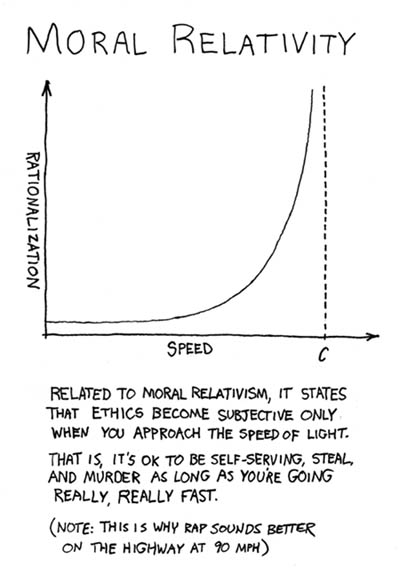
Another problem with the idea is that Special Relativity doesn't say everything is relative. Previous to Special Relativity, we used what we retrospectively call Galilean Relativity. In Galilean Relativity, the distance between two objects, and the time between two events would always remain the same, no matter your frame of reference. Time (Δt) and distance (Δx) are what we call "invariants". In Special Relativity, there is an invariant that combines space and time: what we call the "interval".* That means that though space and time are relative, space-time, taken as a whole, is not. Changing reference frames is analogous to rotating a keyboard (only you're actually rotating space-time). You may have changed the positions of the keys, but the shape of the keyboard stays the same. You may have changed space and time, but some things about space-time never change. For example, the speed of light always remains the same.
What Relativity does tell us is that our intuition of time and space can be incorrect. Our common experiences bias us towards thinking that time is absolute and independent of space, but that's not necessarily the case. Therefore, if you want to philosophize, you should be careful about your assumptions about time and space. If you want to talk about the cause of the universe, you should be careful with ideas like "before" and "after", since these concepts may or may not exist independently of the universe. Furthermore, in these matters, I think it is irrelevant whether Relativity is in fact true. Relativity is just a heads-up to philosophers to be careful with hidden assumptions. Ideally, philosophers would realize this without science's help, but whatever it takes.
*For the record, the equation for the interval is (ΔS)2 = (Δx)2 - (cΔt)2
In general, I feel the answer is that, no, physics does not tell us much about metaphysics. Furthermore, people who try to connect physics and metaphysics are often engaged in gross abuse of the science. Much more often, physics only helps us realize how much we don't know about metaphysics.
I've already tried to explain Special Relativity (Explained: 1, 2, 3), so I'm going to use it as an example to demonstrate my point.
First off, Relativity is not even related to Moral Relativism, or indeed any sort of subjectivist philosophy. They have nothing to do with each other. Yes, Relativity suggests that different observers can have different perceptions of time and space. But "observer" is a technical term that ultimately has no connection to humans, much less human ethical theory. Similarly, the details of time and space have little to do with ethics. If I say that time and space depend on your frame of reference, "frame of reference" is a technical term that depends on your velocity, not your point of view. People seem to think that Relativity tells us, "It all depends on your point of view," but the more accurate statement is, "It all depends on your direction and magnitude of motion." I guess that just doesn't have the same ring to it.
Another problem with the idea is that Special Relativity doesn't say everything is relative. Previous to Special Relativity, we used what we retrospectively call Galilean Relativity. In Galilean Relativity, the distance between two objects, and the time between two events would always remain the same, no matter your frame of reference. Time (Δt) and distance (Δx) are what we call "invariants". In Special Relativity, there is an invariant that combines space and time: what we call the "interval".* That means that though space and time are relative, space-time, taken as a whole, is not. Changing reference frames is analogous to rotating a keyboard (only you're actually rotating space-time). You may have changed the positions of the keys, but the shape of the keyboard stays the same. You may have changed space and time, but some things about space-time never change. For example, the speed of light always remains the same.
What Relativity does tell us is that our intuition of time and space can be incorrect. Our common experiences bias us towards thinking that time is absolute and independent of space, but that's not necessarily the case. Therefore, if you want to philosophize, you should be careful about your assumptions about time and space. If you want to talk about the cause of the universe, you should be careful with ideas like "before" and "after", since these concepts may or may not exist independently of the universe. Furthermore, in these matters, I think it is irrelevant whether Relativity is in fact true. Relativity is just a heads-up to philosophers to be careful with hidden assumptions. Ideally, philosophers would realize this without science's help, but whatever it takes.
*For the record, the equation for the interval is (ΔS)2 = (Δx)2 - (cΔt)2
Subscribe to:
Posts (Atom)


