
This is the final post in my series on debugging the ontological argument.
In this series, I've already rebutted every form of the ontological argument that can be expressed logically, but of course that was never really the point of the series. The point is to dive into technical details and learn a bit about logic and philosophy. Keeping with that spirit, this, the final post of the series, will go off on a complete tangent.
The central question I want to discuss is, what is necessary existence?
Sameness across modalities
In modal logic, necessary existence can be tricky to define, because we don't really have a sense of "sameness" across possible worlds. Suppose there's an alternate timeline where I become a mathematician instead of a physicist. Is that alternate version of me the "same" as me? Could you say that I exist across both of these possible worlds?
By Gödel's definition of necessary existence, I do not exist across both worlds. An alternate version of me is only considered the "same" if it has all the same properties as me. Symbollically, the definition is: $$\forall x ~NE(x) \Leftrightarrow \forall Z~[Z~ess~x \Rightarrow \square\exists y~ Z(y)]\tag{1}\label{1}$$ In English this says "x has necessary existence if given any essential property of x, there necessarily exists an object with that same property." Next we have to define what an essential property is. $$\forall Z \forall x ~ \{Z~ess~x \Leftrightarrow Z(x) \wedge \forall Y ~ [ Y(x) \Rightarrow (Z \rightarrow Y) ] \}\tag{2}\label{2}$$ In English, this is "Z is an essential property of x if Z is a property of x, and also entails all properties of x."
A few things immediately follow from the definition of essential properties. First, we can prove that each object has exactly one unique essential property. The essential property, or "essence" is simply the conjunction of all properties that the object has. Thus if two objects have the same essence, then they have all of their properties in common. In order for something to have necessary existence, then there must exist in every possible world an object which has all the same properties.
Pathological sameness
In my opinion, this is not a very good definition of necessary existence. The idea of two objects sharing all properties is far too strong.
You can come up with a lot of pathological properties. For example, in an earlier post in this series, I defined H(x) to mean "There exists a monk
singing chants in tight leather pants." H(x) does not say anything about whether x is a monk singing chants in tight leather pants, it merely says that x is in the same world as said monk. If x has Gödel's necessary existence, then we would conclude that monks singing chants in tight leather pants exist in all possible worlds, or none of them.
Or consider another kind of pathological property, PS which is the property that object x belongs to set S. The set S can be chosen arbitrarily. In fact, why not just choose S to include exactly one object x in one possible world? No other objects in any other possible world will share property PS, so we can conclude that x does not necessarily exist.1
Now suppose we have an object which is a candidate for God. As above, we prove that this object does not necessarily exist, and is therefore not God. How's that for a reverse ontological argument?
I am convinced, however, that this is a purely technical problem in Gödel's argument, and that it could be fixed, although not in any elegant way. Rather than considering two objects to be equal if they share all properties, we can consider them equal if they share all "relevant" properties. "Relevance" can be a second-order predicate, just like "positivity", only it obeys different axioms: $$\forall
Z \forall Y~ (R(Z) \wedge (Z \rightarrow Y) ) \Rightarrow R(Y)\tag{R1}\label{R1}$$ $$R(\lnot Z) \Leftrightarrow R(Z)\tag{R2}\label{R2}$$ $$\forall Z~R (Z) \Rightarrow \square R(Z)\tag{R3}\label{R3}$$ $$\lnot R(H)\tag{R4}\label{R4}$$ $$R(B)\tag{R5}\label{R5}$$ H is the property of existing in a world that has a singing monk, and B is the property of being a singing monk.2
I'm sure you could use the axiom of choice to construct an acceptable second-order predicate somehow. Etc. etc., therefore God exists. Now you're convinced, right?
-----------------------------------------------
1. I'm assuming that there is more than one possible world. If there is only one possible world, then every object in it necessarily exists.
2. Fun exercise: prove that the axioms I chose are inconsistent.
Showing posts with label reasoning. Show all posts
Showing posts with label reasoning. Show all posts
Friday, September 18, 2015


Sunday, September 6, 2015
Gödel's positive predicates
This is part of my series on debugging the ontological argument.
As explained in the previous post, the basic structure of Gödel's Ontological Argument (GOA) is to first prove the "consistency" of God, and then it follows that God must exist. In this post, I will how we prove God's consistency.
The GOA introduces a second order predicate, that is, a predicate that is applied to other predicates. This second order predicate is called "positivity", but the name is more suggestive than meaningful. For example, we could say that the property of being red is a "positive" property, or we could say that being red is not a positive property. Symbolically, we would write this as $$P(R)\tag{1}\label{1}$$ where R means "is red" and P means "is positive".
GOA at first appears to stipulate a definition of "positivity", and of course it is fine to stipulate a new definition for a new concept. But my objection is that the definition is poorly formed.
Too many premises
The GOA takes the following premises about "positivity":
$\ref{P1}$: If positive predicate Z entails1 predicate Y, then Y is also positive.
$\ref{P2}$: Given any predicate and its negation, exactly one of them is positive.
$\ref{P3}$: The conjunction of all positive predicates (called "God-like") is itself a positive predicate.
$\ref{P4}$: If a predicate is positive, then it is necessarily positive.
$\ref{P5}$: Necessary existence is positive. Necessary existence basically means that in every possible world there is a copy of the given object.
And in symbolic logic:2 $$\forall Z \forall Y~ (P(Z) \wedge (Z \rightarrow Y) ) \Rightarrow P(Y)\tag{P1}\label{P1}$$ $$\forall Z~ P(\lnot Z) \Leftrightarrow \lnot P(Z)\tag{P2}\label{P2}$$ $$P(G);\qquad \text{Definition of G:}~ \forall Z~ P(Z) \Rightarrow (G \rightarrow Z)\tag{P3}\label{P3}$$ $$\forall Z~ P(Z) \Rightarrow \square P(Z)\tag{P4}\label{P4}$$ $$P(NE)\tag{P5}\label{P5}$$ I leave out the logical definition of necessary existence because it's very technical and not relevant yet.
The GOA is not an especially popular form of the ontological argument, and perhaps now you can see why. It gets rid of some of the questionable premises in other ontological arguments, but it replaces them with five whole new ones. Five! It's easy enough to just say, one of those premises must be wrong.
Indeed, I can't think of any reason we should think that any of the premises are true. As far as I can tell, the proof is not referring to any natural concept of "positivity".3 In particular, I don't see why every property either needs to be positive or its negation does. What if being red is positive in some contexts, but in other contexts it's better to be not red? Or what if it's positive in this world, but there's a possible world where it's not positive?
Indeed, we can stop here, as far as rebutting the GOA is concerned. It sure is a fancy argument, too bad its premises aren't remotely persuasive.
But the purpose of this series is to dig deeper. So we turn to the question: exactly which of the premises is wrong?
Stipulative definitions
Since "positivity" obviously doesn't correspond to any real concept of positivity as far as I know, the only way I can interpret the word is simply as a placeholder. We're creating a whole new concept, and "positivity" is just the name we gave it. And since it's a whole new concept, we can stipulate whatever definition we like for it.
Indeed, I believe that none of the premises are individually "wrong". "Positivity" is a meaningless word, and we're allowed to stipulate certain things about it. Any of the premises, taken individually, I find acceptable to stipulate as a partial definition. Taken together, however, there might be an issue.
It is not true that you can stipulate just any definition for a word. The Stanford Encyclopedia of Philosophy lists two criteria that a stipulative definition must follow, the first of which is relevant here:
What's happening here, mechanically, is that the definition of positivity is overly constraining. As a second-order predicate, "positivity" has only so many degrees of freedom. As we give it partial definitions, we are constraining its degrees of freedom, but at some point we begin also to make constraints on the world (or on the set of possible worlds).4
It's quite similar to giving a single word two definitions. I can define a "foo" as an eight-legged snake, and I can define a "foo" as Socrates, and either of those definitions are fine on their own. Taken together, they can be used to prove that Socrates is an eight-legged snake, which is a sign the definitions too constraining (even if by a quirk of history it turned out to be true that Socrates was an eight-legged snake).
If I were to pinpoint any of the five premises as particularly problematic, I would say that the $\ref{P1}$ is. The concept of entailment is based on the material conditional, which as I argued previously is a very counterintuitive concept. Using this premise, if any impossible predicate is positive then all predicates are positive. I'm not sure what "positivity" is really intended to signify, but this premise would seem to go against the spirit of it.
------------------------------
1. As explained in the previous post, entailment means necessary implication. In the case of predicates, if Z entails Y, then it is necessary that for every object which has predicate Z, it also has predicate Y.
2. Here are some details on how the proof follows from these premises. Using premises $\ref{P1}$ and $\ref{P2}$, we can prove that all positive predicates are strictly consistent. If a positive predicate were not strictly consistent, then it would entail a both Z and not Z, which would mean that both Z and not Z are positive predicates, which contradicts $\ref{P2}$. Using the rest of the premises, we show that being God-like is positive, and therefore strictly consistent.
3. According to Gödel, "Positive means positive in the moral aesthetic sense (independently of the accidental structure of the world)". Thus it is clear that he intended to capture some sort of natural concept of positivity, although I think the proof fails to live up to these intentions. I will disregard Gödel's intentions with the hope of exploring the best possible version of the proof.
4. Premises P1, P2, and P5 suffice to make a constraint on the actual world: they prove that something exists. Just P1 and P2 suffice to constrain the possible worlds: they prove that it is possible that something exists. Though what they prove is trivial, it is a sign that the definition is already too constrained and cannot be stipulated.
As explained in the previous post, the basic structure of Gödel's Ontological Argument (GOA) is to first prove the "consistency" of God, and then it follows that God must exist. In this post, I will how we prove God's consistency.
The GOA introduces a second order predicate, that is, a predicate that is applied to other predicates. This second order predicate is called "positivity", but the name is more suggestive than meaningful. For example, we could say that the property of being red is a "positive" property, or we could say that being red is not a positive property. Symbolically, we would write this as $$P(R)\tag{1}\label{1}$$ where R means "is red" and P means "is positive".
GOA at first appears to stipulate a definition of "positivity", and of course it is fine to stipulate a new definition for a new concept. But my objection is that the definition is poorly formed.
Too many premises
The GOA takes the following premises about "positivity":
$\ref{P1}$: If positive predicate Z entails1 predicate Y, then Y is also positive.
$\ref{P2}$: Given any predicate and its negation, exactly one of them is positive.
$\ref{P3}$: The conjunction of all positive predicates (called "God-like") is itself a positive predicate.
$\ref{P4}$: If a predicate is positive, then it is necessarily positive.
$\ref{P5}$: Necessary existence is positive. Necessary existence basically means that in every possible world there is a copy of the given object.
And in symbolic logic:2 $$\forall Z \forall Y~ (P(Z) \wedge (Z \rightarrow Y) ) \Rightarrow P(Y)\tag{P1}\label{P1}$$ $$\forall Z~ P(\lnot Z) \Leftrightarrow \lnot P(Z)\tag{P2}\label{P2}$$ $$P(G);\qquad \text{Definition of G:}~ \forall Z~ P(Z) \Rightarrow (G \rightarrow Z)\tag{P3}\label{P3}$$ $$\forall Z~ P(Z) \Rightarrow \square P(Z)\tag{P4}\label{P4}$$ $$P(NE)\tag{P5}\label{P5}$$ I leave out the logical definition of necessary existence because it's very technical and not relevant yet.
The GOA is not an especially popular form of the ontological argument, and perhaps now you can see why. It gets rid of some of the questionable premises in other ontological arguments, but it replaces them with five whole new ones. Five! It's easy enough to just say, one of those premises must be wrong.
Indeed, I can't think of any reason we should think that any of the premises are true. As far as I can tell, the proof is not referring to any natural concept of "positivity".3 In particular, I don't see why every property either needs to be positive or its negation does. What if being red is positive in some contexts, but in other contexts it's better to be not red? Or what if it's positive in this world, but there's a possible world where it's not positive?
Indeed, we can stop here, as far as rebutting the GOA is concerned. It sure is a fancy argument, too bad its premises aren't remotely persuasive.
But the purpose of this series is to dig deeper. So we turn to the question: exactly which of the premises is wrong?
Stipulative definitions
Since "positivity" obviously doesn't correspond to any real concept of positivity as far as I know, the only way I can interpret the word is simply as a placeholder. We're creating a whole new concept, and "positivity" is just the name we gave it. And since it's a whole new concept, we can stipulate whatever definition we like for it.
Indeed, I believe that none of the premises are individually "wrong". "Positivity" is a meaningless word, and we're allowed to stipulate certain things about it. Any of the premises, taken individually, I find acceptable to stipulate as a partial definition. Taken together, however, there might be an issue.
It is not true that you can stipulate just any definition for a word. The Stanford Encyclopedia of Philosophy lists two criteria that a stipulative definition must follow, the first of which is relevant here:
A stipulative definition should not enable us to establish essentially new claims—call this the Conservativeness criterion. We should not be able to establish, by means of a mere stipulation, new things about, for example, the moon.The whole project of establishing the existence of God by stipulative definitions, therefore seems rather quixotic. The very success of the proof only demonstrates that the stipulative definition that we began with was wrong.
What's happening here, mechanically, is that the definition of positivity is overly constraining. As a second-order predicate, "positivity" has only so many degrees of freedom. As we give it partial definitions, we are constraining its degrees of freedom, but at some point we begin also to make constraints on the world (or on the set of possible worlds).4
It's quite similar to giving a single word two definitions. I can define a "foo" as an eight-legged snake, and I can define a "foo" as Socrates, and either of those definitions are fine on their own. Taken together, they can be used to prove that Socrates is an eight-legged snake, which is a sign the definitions too constraining (even if by a quirk of history it turned out to be true that Socrates was an eight-legged snake).
If I were to pinpoint any of the five premises as particularly problematic, I would say that the $\ref{P1}$ is. The concept of entailment is based on the material conditional, which as I argued previously is a very counterintuitive concept. Using this premise, if any impossible predicate is positive then all predicates are positive. I'm not sure what "positivity" is really intended to signify, but this premise would seem to go against the spirit of it.
------------------------------
1. As explained in the previous post, entailment means necessary implication. In the case of predicates, if Z entails Y, then it is necessary that for every object which has predicate Z, it also has predicate Y.
2. Here are some details on how the proof follows from these premises. Using premises $\ref{P1}$ and $\ref{P2}$, we can prove that all positive predicates are strictly consistent. If a positive predicate were not strictly consistent, then it would entail a both Z and not Z, which would mean that both Z and not Z are positive predicates, which contradicts $\ref{P2}$. Using the rest of the premises, we show that being God-like is positive, and therefore strictly consistent.
3. According to Gödel, "Positive means positive in the moral aesthetic sense (independently of the accidental structure of the world)". Thus it is clear that he intended to capture some sort of natural concept of positivity, although I think the proof fails to live up to these intentions. I will disregard Gödel's intentions with the hope of exploring the best possible version of the proof.
4. Premises P1, P2, and P5 suffice to make a constraint on the actual world: they prove that something exists. Just P1 and P2 suffice to constrain the possible worlds: they prove that it is possible that something exists. Though what they prove is trivial, it is a sign that the definition is already too constrained and cannot be stipulated.
Wednesday, August 19, 2015
Consistency and the material conditional
This is part of my series on debugging the ontological argument.
In the previous post of this series, I introduced Gödel's Ontological Argument (GOA) by discussing all the things Gödel got right. I also use this discussion as a means of gradually breaking down the argument without throwing all of it in your face at once.1
The three major parts of the GOA are:
- God is consistent (proven in earlier steps, to be discussed in next post).
- If something is consistent, then it is possible.
- If God is possible, then God is necessary (for reasons already discussed).
Material consistency
The intuitive definition of consistency is that there are no contradictions. To say proposition S is consistent is to say that S does not lead to any contradictions. But there's a lot of work done by the phrase "lead to". In logic, we might translate this to logical implication. $$\lnot \exists Q ( S \Rightarrow (Q \wedge \lnot Q) )\tag{1}\label{1}$$ In English, this is "There does not exist a proposition Q such that S implies both Q and not-Q." Here, "implies" is logical implication, also sometimes called the "material conditional".
The material conditional is notorious for causing countless errors in students of math and logic.2 The statement "If S, then R" means that either R is true, or S is false (or both), and it says nothing about the conceptual connection between R and S. For instance, I can say, "If Mars is a giant egg, then the moon is made of cheese." and it would be literally true, because Mars is not in fact a giant egg.
The material conditional makes for a particular definition of consistency, which I will call material consistency.
If S is materially consistent, then S must be true!
The reasoning is actually quite trivial. The only way for a material conditional "If S, then R" to be false, is if S is true and R is false. Thus, if S does not imply a contradiction, then S must be true. In fact, if there is anything whatsoever that S does not imply, then S must be true.
You should find this a rather unsatisfying definition of consistency. Literally everything that is untrue is materially inconsistent. It is inconsistent for me to live in Southern California. It is inconsistent for you to be standing next to me. It is inconsistent for my pen to be out of ink. Is that really what we want to say?
Strict consistency
The major reason that so many people find the material conditional counterintuitive is that we are accustomed to so many other kinds of conditionals in natural language. For example, I am much entertained by these examples documented by Language Log:
If you want to know, 4 isn't a prime number.Language Log refers to these as the biscuit conditional, bleached conditional, and concessive conditional respectively. In my personal experience, it's a standard joke among math and logic enthusiasts to naively interpret a conditional statement using the material conditional even when it doesn't make sense.
If Eskimos have dozens of words for snow, Germans have as many for bureaucracy.
It's all perfectly normal — if troublesome to varying degrees.
But even when people are using a more logical kind of conditional, they are often thinking of more than just the material conditional. For example, the statement, "If Mars is a giant egg, then the moon is made of cheese," might mean that Mars being a giant egg might somehow physically cause the moon to be made of cheese. Or perhaps it means that given the counterfactual universe where mars is a giant egg, then the moon would also be made of cheese.
Since this series is primarily concerned with what can be translated to symbolic logic, we will take a particular conditional called the "strict conditional", also called entailment. Symbolically, I'll distinguish between implication and entailment by using different kinds of arrows: $$S \Rightarrow R\tag{2}\label{2}$$ $$S \rightarrow R \tag{3}\label{3}$$ Statement \ref{2} means "S implies R", while statement \ref{3} means "S entails R". S is said to entail R if S implies R in all possible worlds. We've already built modal logic to make sense of the concept of possibility, so we might as well use it.
The strict conditional leads to another definition of consistency, which I will call strict consistency. "S is strictly consistent" means $$\lnot \exists Q ( S \rightarrow (Q \wedge \lnot Q) )\tag{4}\label{4}$$ If S is strictly consistent, then S must be possible.
This follows trivially, since if S does not entail a contradiction, then there must be at least one possible world where S does not imply a contradiction. As argued before, if S does not imply a contradiction in some possible world, then S is true in that possible world.
Why this is unsatisfying
In my history of arguing about the ontological argument, I find that some people find it "obvious" that God is consistent. There's simply no contradiction to be had in the definition of a perfect being. And then, you hardly need the rest of the GOA, you just assert that God therefore exists.
The problem I have with this argument is, what kind of consistency do you think is so obvious? The very idea of strict consistency has nothing whatsoever to do with the definition of God, so it doesn't matter how sensible (or insensible) the definition of God is. All that matters is whether God exists in a possible world. If not, then God implies a contradiction, because using the material conditional, God implies absolutely everything.
Furthermore, the idea of strict consistency relies on the idea of possibility, which in turn relies on our choice of modal logic semantics.
For example, consider the statement, "If the moon is made of cheese." Let's consider "possibility" to refer to all possible pasts and futures. I don't believe that the moon is made of cheese in any possible past or future, therefore, the very idea is strictly inconsistent.
Now, let's consider "possibility" to instead refer to all universes with the same physical laws. I believe it's physically possible to have a moon with the same chemical makeup as cheese, and thus we would say that the idea is strictly consistent. But which is it? Is a moon made of cheese consistent or inconsistent?
In the next post, I will discuss how God's consistency is proven in the context of the GOA.
------------------------------
1. If for some reason you really do want the entire argument thrown at you all at once, I wrote up Gödel's ontological argument step by step in 2009.
2. A good exercise, if you've never seen it, is to try the Wason selection task. The task is, given a number of cards in front of you, to decide which cards need to be flipped to verify a particular hypothesis about them.
Tuesday, August 4, 2015
Godel's workarounds to the ontological argument
This is part of my series on debugging the ontological argument.
In the previous post, I discussed Plantinga's modal ontological argument, which is about the simplest modal ontological argument you can get. A simply-stated argument is quite valuable, but I believe that as a matter of technical feat, Plantinga's argument was surpassed by Gödel's Ontological argument (GOA).
This series does not focus on history, but I will dryly summarize a few established facts. Gödel formulated the argument in 1941, but only told people about it in 1970. Gödel did not actually believe that the argument proved God, and was afraid that publishing it would send that message. He was more interested in it from the perspective of logical investigation (which is my interest as well). It was published posthumously in 1987, which as far as I know predates Plantinga's argument.
Long story short, I've gotten several people who said stuff like (actual quote), "The first premise you must accept is that Godel was almost certainly much, much, smarter than you." And besides being the worst kind of argument from authority it's also historically wrong about Gödel's motivations.
But it is true, after all, that Gödel was very smart, and I find the GOA to be quite clever in ways that are not immediately obvious. This post will focus on several things that the GOA got right.
1. Possibility is proven, not assumed
In the conceptual ontological argument, we had difficulty with the premise that God was "conceivable" in the sense required by the proof. In the modal ontological argument, we had difficulty with the premise that God was "possible" in the sense required by the proof. In the GOA, we don't need to assume that God is possible. Instead, we prove it from more basic premises.
The basic structure of the GOA is as follows:
1. We define what is a positive property.
2. Using the definition of positive properties, we prove that positive properties are always consistent.
3. We prove that consistent properties are always possible.
4. The property of being God is taken to be positive.
5. Therefore God is possible.
6. Therefore God is necessary (this part of the proof is identical to Plantinga's argument).
If you're interested in the particulars, I wrote out the entire ontological argument years ago. The goal in this series is to explain the steps in more depth rather than detail.
2. Existence is a predicate
Earlier in this series, I wasted much time with an in depth discussion of whether existence is a predicate. In a first analysis, it cannot be a predicate, or at least not a very useful one. In later analysis, I note that existence can be a predicate after all, under certain conditions. One possible condition is if we use second order predicate logic (SOPL), and that is what the GOA does.
In more detail, the GOA defines necessary existence as follows:
$$E(x) \Rightarrow \forall\phi~ (\phi~ess~x \Rightarrow \square \exists y~ \phi(y) )\tag{1}\label{ref1}$$
In plain language, necessary existence (E) means that in all (accessible) possible worlds, there exists an object with all exactly the same properties. This requires SOPL since it applies a quantifier to a predicate ($\phi$). In my opinion, this completely answers Kant's objection to the ontological argument.
You might notice that \ref{ref1} includes the phrase "$\phi~ess~x$" which means "$\phi$ is the essence of x". This simply means that $\phi$ is the conjunction of all properties of x.
3. God's definition is no longer fluff
Earlier in the series, I complained that many version of the ontological argument have completely pointless augmentations. They define God as a maximally great being, or a being with all the perfections, and this uses far more assumptions than is necessary.
In the GOA, God is defined as a being which has the conjunction of all positive properties, but this is actually a crucial component of the proof! The entirety of the proof hinges on the definition of "positive properties", and there isn't an obvious way to reformulate the argument without it.
In fact, it almost seems too powerful. One of the objections to the GOA is that God would even have positive properties that describe the world that God lives in, rather than God himself. For instance, God would have the property that "trivialknot likes cake." And since God necessarily exists, God would have this same property in all possible worlds, implying that I like cake in all possible worlds.
Because Gödel cleverly addressed so many of the standard problems with other ontological arguments, I will have to devote several more posts to the particular flaws in his argument.
In the previous post, I discussed Plantinga's modal ontological argument, which is about the simplest modal ontological argument you can get. A simply-stated argument is quite valuable, but I believe that as a matter of technical feat, Plantinga's argument was surpassed by Gödel's Ontological argument (GOA).
This series does not focus on history, but I will dryly summarize a few established facts. Gödel formulated the argument in 1941, but only told people about it in 1970. Gödel did not actually believe that the argument proved God, and was afraid that publishing it would send that message. He was more interested in it from the perspective of logical investigation (which is my interest as well). It was published posthumously in 1987, which as far as I know predates Plantinga's argument.
Long story short, I've gotten several people who said stuff like (actual quote), "The first premise you must accept is that Godel was almost certainly much, much, smarter than you." And besides being the worst kind of argument from authority it's also historically wrong about Gödel's motivations.
But it is true, after all, that Gödel was very smart, and I find the GOA to be quite clever in ways that are not immediately obvious. This post will focus on several things that the GOA got right.
1. Possibility is proven, not assumed
In the conceptual ontological argument, we had difficulty with the premise that God was "conceivable" in the sense required by the proof. In the modal ontological argument, we had difficulty with the premise that God was "possible" in the sense required by the proof. In the GOA, we don't need to assume that God is possible. Instead, we prove it from more basic premises.
The basic structure of the GOA is as follows:
1. We define what is a positive property.
2. Using the definition of positive properties, we prove that positive properties are always consistent.
3. We prove that consistent properties are always possible.
4. The property of being God is taken to be positive.
5. Therefore God is possible.
6. Therefore God is necessary (this part of the proof is identical to Plantinga's argument).
If you're interested in the particulars, I wrote out the entire ontological argument years ago. The goal in this series is to explain the steps in more depth rather than detail.
2. Existence is a predicate
Earlier in this series, I wasted much time with an in depth discussion of whether existence is a predicate. In a first analysis, it cannot be a predicate, or at least not a very useful one. In later analysis, I note that existence can be a predicate after all, under certain conditions. One possible condition is if we use second order predicate logic (SOPL), and that is what the GOA does.
In more detail, the GOA defines necessary existence as follows:
$$E(x) \Rightarrow \forall\phi~ (\phi~ess~x \Rightarrow \square \exists y~ \phi(y) )\tag{1}\label{ref1}$$
In plain language, necessary existence (E) means that in all (accessible) possible worlds, there exists an object with all exactly the same properties. This requires SOPL since it applies a quantifier to a predicate ($\phi$). In my opinion, this completely answers Kant's objection to the ontological argument.
You might notice that \ref{ref1} includes the phrase "$\phi~ess~x$" which means "$\phi$ is the essence of x". This simply means that $\phi$ is the conjunction of all properties of x.
3. God's definition is no longer fluff
Earlier in the series, I complained that many version of the ontological argument have completely pointless augmentations. They define God as a maximally great being, or a being with all the perfections, and this uses far more assumptions than is necessary.
In the GOA, God is defined as a being which has the conjunction of all positive properties, but this is actually a crucial component of the proof! The entirety of the proof hinges on the definition of "positive properties", and there isn't an obvious way to reformulate the argument without it.
In fact, it almost seems too powerful. One of the objections to the GOA is that God would even have positive properties that describe the world that God lives in, rather than God himself. For instance, God would have the property that "trivialknot likes cake." And since God necessarily exists, God would have this same property in all possible worlds, implying that I like cake in all possible worlds.
Because Gödel cleverly addressed so many of the standard problems with other ontological arguments, I will have to devote several more posts to the particular flaws in his argument.
Thursday, July 23, 2015
Gods are unimaginably unlikely
The main reason I don't believe in gods now is different from the reason I had when I stopped believing about nine years ago. Nine years ago, I would have merely said that the arguments for God were lacking. I am even less charitable today, because I don't think there's any reason to consider God as a hypothesis in the first place. We do have social reasons to talk about God, but as far as truth-seeking is concerned, the probability of God is so low that by even thinking about it we're tipping the scales.
This is not the argument I would use to try to persuade people of atheism. My way of thinking of it is too technical. And it advances a position that is far stronger than is socially necessary for an atheistic society. What does it matter to me whether you believe the probability of God is unimaginably low, or just extremely low?
But then, I'm not really in the business of directly persuading people to atheism in general. Just talking about stuff is more fun.
Generally, a good model for thinking about degrees of belief is to speak of Bayesian probabilities. You might start with "neutral" priors, such as God having a 50% chance to exist. Then you consider all the evidence and arguments for and against God, and modify the probability accordingly. An atheist would likely look at the evidence, and think that the problem of evil and problem of divine silence weigh heavily against the existence of God, and that none of the usual arguments in favor of god are effective. But under such an analysis, how low would you really rate the probability of God? I think you would rate it very low, but not unimaginably low.
I rate the probability of God even lower than that, basically because I go beyond the basic Bayesian analysis. I think assigning a 50% prior probability to God is already far too favorable.
As far as theories of the world go, the idea of God is extremely peculiar and narrow. The ideas of consciousness and intentionality are ordinary to us, because that's the kind of life that matter and evolution produce for us. But to theorize about consciousness and intentionality which exists prior to the laws of physics is very strange. And that's before even introducing our even more peculiar ideas of morality.
It reminds me when non-physicists think that quantum mechanics is so strange, that there must be something beyond quantum mechanics. It is true that quantum mechanics is strange, but strangeness is relative to our own experience in the world that emerges on large scales. What makes quantum mechanics strange is that it produces a world which looks entirely different on small and large scales.
Now it could very well be that there is something underneath quantum mechanics, and that quantum mechanics simply emerges from more fundamental rules. I think it likely, even. But why would we ever think that what's underneath would look similar to what's above? Whatever's under quantum mechanics will not look like classical physics, it will look even stranger than ever.
The idea of a god is basically the theory that what's at the very bottom (a god underlying the entire universe) is similar to what's at the very top (intelligence emergent from complex biological processes) even though the bulk of the middle looks entirely different. It doesn't make sense to even propose such a thing, and it makes all too much sense that we as humans would propose it anyway.
The other thing you may have noticed is that the existence of God is not at all obvious in our world. God is intangible, except in our minds where the same feelings could be caused by any number of things. The only miracles performed are unverifiable, and split across mutually contradictory religions. This would be overwhelming evidence against a god, except that theists have basically tailored their conception of god to avoid it.
Of course god is intangible. Of course god only touches our minds. Of course god is like us since he made us in his image. Of course god is leery of showing himself directly. As for the problem of evil, god is just too difficult for our minds to understand (but apparently familiar enough that we can have called god "good" in the first place).
With all these preconceptions built in, gods at least aren't completely eliminated by the evidence. But when you tailor the god hypothesis like that, you are basically making the god hypothesis even more specific and more strange than ever. As discussed in a previous post, this is basically an exploitation of the definition of evidence. By tailoring your theory just right, it is possible to find a theory which is "favored" by the evidence or at least not completely eliminated by it. But by doing so, you've ultimately chosen a theory which is more unlikely than ever.
Is there any evidence that could make me believe in a god? Probably--I mean, a complete change in every aspect of the universe would be fairly persuasive. But the problems with god as an idea come even before we talk about evidence.
This is not the argument I would use to try to persuade people of atheism. My way of thinking of it is too technical. And it advances a position that is far stronger than is socially necessary for an atheistic society. What does it matter to me whether you believe the probability of God is unimaginably low, or just extremely low?
But then, I'm not really in the business of directly persuading people to atheism in general. Just talking about stuff is more fun.
Generally, a good model for thinking about degrees of belief is to speak of Bayesian probabilities. You might start with "neutral" priors, such as God having a 50% chance to exist. Then you consider all the evidence and arguments for and against God, and modify the probability accordingly. An atheist would likely look at the evidence, and think that the problem of evil and problem of divine silence weigh heavily against the existence of God, and that none of the usual arguments in favor of god are effective. But under such an analysis, how low would you really rate the probability of God? I think you would rate it very low, but not unimaginably low.
I rate the probability of God even lower than that, basically because I go beyond the basic Bayesian analysis. I think assigning a 50% prior probability to God is already far too favorable.
As far as theories of the world go, the idea of God is extremely peculiar and narrow. The ideas of consciousness and intentionality are ordinary to us, because that's the kind of life that matter and evolution produce for us. But to theorize about consciousness and intentionality which exists prior to the laws of physics is very strange. And that's before even introducing our even more peculiar ideas of morality.
It reminds me when non-physicists think that quantum mechanics is so strange, that there must be something beyond quantum mechanics. It is true that quantum mechanics is strange, but strangeness is relative to our own experience in the world that emerges on large scales. What makes quantum mechanics strange is that it produces a world which looks entirely different on small and large scales.
Now it could very well be that there is something underneath quantum mechanics, and that quantum mechanics simply emerges from more fundamental rules. I think it likely, even. But why would we ever think that what's underneath would look similar to what's above? Whatever's under quantum mechanics will not look like classical physics, it will look even stranger than ever.
The idea of a god is basically the theory that what's at the very bottom (a god underlying the entire universe) is similar to what's at the very top (intelligence emergent from complex biological processes) even though the bulk of the middle looks entirely different. It doesn't make sense to even propose such a thing, and it makes all too much sense that we as humans would propose it anyway.
The other thing you may have noticed is that the existence of God is not at all obvious in our world. God is intangible, except in our minds where the same feelings could be caused by any number of things. The only miracles performed are unverifiable, and split across mutually contradictory religions. This would be overwhelming evidence against a god, except that theists have basically tailored their conception of god to avoid it.
Of course god is intangible. Of course god only touches our minds. Of course god is like us since he made us in his image. Of course god is leery of showing himself directly. As for the problem of evil, god is just too difficult for our minds to understand (but apparently familiar enough that we can have called god "good" in the first place).
With all these preconceptions built in, gods at least aren't completely eliminated by the evidence. But when you tailor the god hypothesis like that, you are basically making the god hypothesis even more specific and more strange than ever. As discussed in a previous post, this is basically an exploitation of the definition of evidence. By tailoring your theory just right, it is possible to find a theory which is "favored" by the evidence or at least not completely eliminated by it. But by doing so, you've ultimately chosen a theory which is more unlikely than ever.
Is there any evidence that could make me believe in a god? Probably--I mean, a complete change in every aspect of the universe would be fairly persuasive. But the problems with god as an idea come even before we talk about evidence.
Monday, July 20, 2015
Plantinga's Modal Ontological Argument
This is part of my series on debugging the ontological argument.
Finally, after explaining modal logic basics, I'm going to talk about Plantinga's Modal Ontological Argument (MOA).1 This argument takes as its centerpiece the following premise: $$G \Rightarrow \square G\tag{1}$$ G is the statement "God exists". This premise is actually quite clever, because it's hardly an assumption at all, but a definition of God. In order for an object to be God, then the same object must exist in all accessible worlds.2
This definition of God has the funny property that it depends on our choice of frame. Even if you would call an object God in one frame, you might not be able to call it God in another frame. As I explained before, frames are simply constructions and it seems odd that whether we call something God should depend on something so arbitrary. Nonetheless, this difficulty can be overcome if we simply specify a frame as part of God's definition. I'm not sure if this is what Plantinga does, but I'll propose a reasonable frame.
In this frame, let's say that world w is accessible from u if w is a possible past or future of u, or some combination (such as the possible past of a possible future). God is taken to be some object which can never start existing, nor stop existing. Thus if God exists, then God exists in all accessible worlds. This justifies the premise \ref{ref1}.
Since premise 1 can be justified as a definition, we must look to the rest of the MOA for problems.
Statement of the Modal Ontological Argument
If you understand S5 modal logic well enough, the MOA is actually quite obvious. If God is possible, then God exists in a world which is accessible from here. And therefore God is also here. More formally:
$$G \Rightarrow \square G\label{ref1}\tag{1}$$ $$\Diamond G\label{ref2}\tag{2}$$ $$\therefore G\label{ref3}\tag{3}$$
For those interested, I also include the formal justification for conclusion \ref{ref3}. In parentheses, I cite the premises and S5 axioms in use.
$$\Diamond \lnot G \Rightarrow \lnot G~(\ref{ref1})\label{3a}\tag{3a}$$ $$\square( \Diamond \lnot G \Rightarrow \lnot G)~(\mathrm{N~and~\ref{3a}})\label{3b}\tag{3b}$$ $$\square\Diamond \lnot G \Rightarrow \square \lnot G~(\mathrm{K~and~\ref{3b}})\label{3c}\tag{3c}$$ $$\Diamond \lnot G \Rightarrow \square \Diamond \lnot G~(\mathrm{s5})\label{3d}\tag{3d}$$ $$\Diamond \lnot G \Rightarrow \square \lnot G~(\mathrm{\ref{3c}~and~\ref{3d}})\label{3e}\tag{3e}$$ $$\Diamond G \Rightarrow \square G~(\mathrm{\ref{3e}})\label{3f}\tag{3f}$$ $$\square G~(\mathrm{\ref{3f}~and~\ref{ref2}})\label{3g}\tag{3g}$$ $$G~(\mathrm{T~and~\ref{3g}})\label{3h}\tag{3h}$$
Yes, this is logically valid. All that remains is to justify premise \ref{ref2}, the statement that God is possible.
Is God possible?
Not many people put stock in ontological arguments, and indeed, neither does Alvin Plantinga, even though he formalized the MOA. Instead, Plantinga merely argues that it is reasonable to think that God is possible, and therefore it is reasonable to believe that God exists.3
The problem is that possibility can mean oh so many different things. Even if we confine ourselves to Kripke semantics, the meaning of possibility depends on our precise choice of frame. As for the proof, it requires a very particular meaning of possibility. Even if it is reasonable to believe God is possible, is it reasonable in the sense required by the proof?
For example, if you take the definition of accessibility that I used in the introduction, then the MOA can be phrased like so: "God existed some time in the past or future. Since God by nature cannot begin to exist or stop existing, then God also exists now." This isn't very compelling, because saying that God existed at some point in the past or future is a pretty major assumption. I am no more likely to believe the assumption than I am to believe the conclusion.
Or suppose we had a broader accessibility relation. Suppose that world u is accessible from world w if and only if the two worlds obey the same physical laws. In this case, it's not clear to me how premise \ref{ref1} follows from a natural definition of God. But let's just take that definition and be careful about the verification of any object as God. The MOA can be phrased like so: "God exists in some possible world with the same physical laws as ours. By definition, God must exist in all worlds with those physical laws. Therefore he exists in our world."
This isn't very compelling because it raises the question, how do we verify that a particular object is God? In order to check the object against the definition of God, we have to check all accessible worlds to see whether the same object exists in those. Maybe that's not so bad if we chose a frame where there aren't so many possible worlds, but there is one world we need to check no matter what: our own world. But by the time that you've verified God exists in our world, what need is there for the MOA? The MOA is in this interpretation "useless".
While Plantinga argues that the premise of the MOA is "reasonable", we can see that this has no value. It does not matter whether we believe in gods or not; because the MOA is "useless", it should not advance our belief in God even a little bit.
------------------------------------------------
1. I'm really considering the simplest possible form of the modal ontological argument, skipping some steps for aesthetic reasons. Plantinga's full argument can be found here.
2. For the moment we'll just forget about the problem of how to say that two objects in two separate possible worlds are the "same". We'll also forget about whether existence is a predicate. These are serious problems, but purely technical ones that will be solved later.
3. One thing you may not have known about Plantinga is that he has written an awful lot about his "reformed epistemology", and I'm sure he has something very particular in mind when he says the premise is "reasonable." I am not familiar with Plantinga's reformed epistemology and won't address it.
Finally, after explaining modal logic basics, I'm going to talk about Plantinga's Modal Ontological Argument (MOA).1 This argument takes as its centerpiece the following premise: $$G \Rightarrow \square G\tag{1}$$ G is the statement "God exists". This premise is actually quite clever, because it's hardly an assumption at all, but a definition of God. In order for an object to be God, then the same object must exist in all accessible worlds.2
This definition of God has the funny property that it depends on our choice of frame. Even if you would call an object God in one frame, you might not be able to call it God in another frame. As I explained before, frames are simply constructions and it seems odd that whether we call something God should depend on something so arbitrary. Nonetheless, this difficulty can be overcome if we simply specify a frame as part of God's definition. I'm not sure if this is what Plantinga does, but I'll propose a reasonable frame.
In this frame, let's say that world w is accessible from u if w is a possible past or future of u, or some combination (such as the possible past of a possible future). God is taken to be some object which can never start existing, nor stop existing. Thus if God exists, then God exists in all accessible worlds. This justifies the premise \ref{ref1}.
Since premise 1 can be justified as a definition, we must look to the rest of the MOA for problems.
Statement of the Modal Ontological Argument
If you understand S5 modal logic well enough, the MOA is actually quite obvious. If God is possible, then God exists in a world which is accessible from here. And therefore God is also here. More formally:
$$G \Rightarrow \square G\label{ref1}\tag{1}$$ $$\Diamond G\label{ref2}\tag{2}$$ $$\therefore G\label{ref3}\tag{3}$$
For those interested, I also include the formal justification for conclusion \ref{ref3}. In parentheses, I cite the premises and S5 axioms in use.
$$\Diamond \lnot G \Rightarrow \lnot G~(\ref{ref1})\label{3a}\tag{3a}$$ $$\square( \Diamond \lnot G \Rightarrow \lnot G)~(\mathrm{N~and~\ref{3a}})\label{3b}\tag{3b}$$ $$\square\Diamond \lnot G \Rightarrow \square \lnot G~(\mathrm{K~and~\ref{3b}})\label{3c}\tag{3c}$$ $$\Diamond \lnot G \Rightarrow \square \Diamond \lnot G~(\mathrm{s5})\label{3d}\tag{3d}$$ $$\Diamond \lnot G \Rightarrow \square \lnot G~(\mathrm{\ref{3c}~and~\ref{3d}})\label{3e}\tag{3e}$$ $$\Diamond G \Rightarrow \square G~(\mathrm{\ref{3e}})\label{3f}\tag{3f}$$ $$\square G~(\mathrm{\ref{3f}~and~\ref{ref2}})\label{3g}\tag{3g}$$ $$G~(\mathrm{T~and~\ref{3g}})\label{3h}\tag{3h}$$
Yes, this is logically valid. All that remains is to justify premise \ref{ref2}, the statement that God is possible.
Is God possible?
Not many people put stock in ontological arguments, and indeed, neither does Alvin Plantinga, even though he formalized the MOA. Instead, Plantinga merely argues that it is reasonable to think that God is possible, and therefore it is reasonable to believe that God exists.3
The problem is that possibility can mean oh so many different things. Even if we confine ourselves to Kripke semantics, the meaning of possibility depends on our precise choice of frame. As for the proof, it requires a very particular meaning of possibility. Even if it is reasonable to believe God is possible, is it reasonable in the sense required by the proof?
For example, if you take the definition of accessibility that I used in the introduction, then the MOA can be phrased like so: "God existed some time in the past or future. Since God by nature cannot begin to exist or stop existing, then God also exists now." This isn't very compelling, because saying that God existed at some point in the past or future is a pretty major assumption. I am no more likely to believe the assumption than I am to believe the conclusion.
Or suppose we had a broader accessibility relation. Suppose that world u is accessible from world w if and only if the two worlds obey the same physical laws. In this case, it's not clear to me how premise \ref{ref1} follows from a natural definition of God. But let's just take that definition and be careful about the verification of any object as God. The MOA can be phrased like so: "God exists in some possible world with the same physical laws as ours. By definition, God must exist in all worlds with those physical laws. Therefore he exists in our world."
This isn't very compelling because it raises the question, how do we verify that a particular object is God? In order to check the object against the definition of God, we have to check all accessible worlds to see whether the same object exists in those. Maybe that's not so bad if we chose a frame where there aren't so many possible worlds, but there is one world we need to check no matter what: our own world. But by the time that you've verified God exists in our world, what need is there for the MOA? The MOA is in this interpretation "useless".
While Plantinga argues that the premise of the MOA is "reasonable", we can see that this has no value. It does not matter whether we believe in gods or not; because the MOA is "useless", it should not advance our belief in God even a little bit.
------------------------------------------------
1. I'm really considering the simplest possible form of the modal ontological argument, skipping some steps for aesthetic reasons. Plantinga's full argument can be found here.
2. For the moment we'll just forget about the problem of how to say that two objects in two separate possible worlds are the "same". We'll also forget about whether existence is a predicate. These are serious problems, but purely technical ones that will be solved later.
3. One thing you may not have known about Plantinga is that he has written an awful lot about his "reformed epistemology", and I'm sure he has something very particular in mind when he says the premise is "reasonable." I am not familiar with Plantinga's reformed epistemology and won't address it.
Sunday, July 12, 2015
Defining evidence
To define "evidence", a good starting point is the Bayesian definition:
B is evidence for A if P(A|B) > P(A)
In other words, evidence is "anything that increases your belief in a claim." This definition is appealing for a number of reasons. It's sufficiently precise that in principle everything either counts as evidence or it doesn't. And we can apply Bayes' theorem to build an intuition about what counts as evidence.
However, The Barefoot Bum points out a couple deficiencies in the definition. First, just because B is evidence for A does not mean that A is very likely. Second, it is possible to exploited the definition. Here, I only wish to address the first deficiency, but the best illustration of why it is a problem is to show how the definition can be exploited.
Suppose I play a single game of poker with my robot boyfriend. I'm dealt a mediocre hand, with aces high. After we reveal our hands and I lose, we have the following argument:
Essentially, it is possible to exploit the definition of evidence by carefully tailoring the hypothesis to fit hypothesis. In mathematical terms, we are choosing A such that P(A|B) >> P(A), at the cost of making P(A|B) << 1. This is obviously exploitative, because the entire point of evidence is to find out what is true, and yet here we're discussing a hypothesis which is extremely unlikely to be true even after the strong evidence for it.
Unfortunately, the distinction between exploitative and non-exploitative uses of the definition of evidence is not always clear cut. Even in science we do want to tailor our hypotheses to fit the evidence. Just not in that way, you know?
There are three kinds of resolutions to this problem:
1. Stick to the original definition of evidence. Bite the bullet.
2. Formulate another precise definition of evidence.
3. Leave some of the definition up to subjective judgment.
I have, in the past, stuck with the standard definition of evidence. It is useful, for example, to prove that absence of evidence is in fact evidence of absence. That's always true in the technical sense. And then if we want more nuance, we can discuss what makes evidence strong or weak.
On the other hand, the word "evidence" has some value attached to it. Evidence is desirable, laudatory, and the way to truth. If there is a way to use the technical definition of evidence in order to frame what is untruthful as truthful, then maybe there is something wrong with the technical definition.
I think there is a lot of value in a more subjective definition of "evidence", and practically speaking, people are making subjective judgments anyway, so we might as well admit it. But it's at least worth looking for a technical fix. The Barefoot Bum suggests that we speak of evidence as something which favors one hypothesis relative to another mutually exclusive hypothesis:
C is evidence for hypothesis A relative to hypothesis B if P(A|C)/P(B|C) > P(A)/P(B)
This definition is still exploitable if we carefully tailor our hypotheses. However, we can add the restriction that A and B are only comparable if they receive similar degrees of tailoring. Thus we retain the ability to tailor hypotheses while removing the ability to do so in an exploitative way.
B is evidence for A if P(A|B) > P(A)
In other words, evidence is "anything that increases your belief in a claim." This definition is appealing for a number of reasons. It's sufficiently precise that in principle everything either counts as evidence or it doesn't. And we can apply Bayes' theorem to build an intuition about what counts as evidence.
However, The Barefoot Bum points out a couple deficiencies in the definition. First, just because B is evidence for A does not mean that A is very likely. Second, it is possible to exploited the definition. Here, I only wish to address the first deficiency, but the best illustration of why it is a problem is to show how the definition can be exploited.
Suppose I play a single game of poker with my robot boyfriend. I'm dealt a mediocre hand, with aces high. After we reveal our hands and I lose, we have the following argument:
Robot boyfriend: This is evidence that you cheated![note: this is not a realistic scenario since we don't like poker.]
Trivialknot: That's absurd! This is a typical hand.
Robot boyfriend: But there is no typical poker hand. There are millions of possible hands, and each is very unlikely.
Trivialknot: You are correct, but surely if I cheated by choosing a hand for myself, this hand would be even more atypical.
Robot boyfriend: You're right. Let's instead consider the hypothesis that you cheated and gave yourself this particular hand.
Trivialknot: Why would I do that?
Robot boyfriend: Who knows, but we can see the evidence for it right in front of us. This is an atypical hand to be dealt randomly, but an extremely typical hand for someone who wants to cheat their way into a 3 of spades, 5 of hearts, 7 of diamonds, 8 of spades, and ace of hearts!
Trivialknot: And I would have gotten away with it too if it weren't for your Bayesian analysis!
Essentially, it is possible to exploit the definition of evidence by carefully tailoring the hypothesis to fit hypothesis. In mathematical terms, we are choosing A such that P(A|B) >> P(A), at the cost of making P(A|B) << 1. This is obviously exploitative, because the entire point of evidence is to find out what is true, and yet here we're discussing a hypothesis which is extremely unlikely to be true even after the strong evidence for it.
Unfortunately, the distinction between exploitative and non-exploitative uses of the definition of evidence is not always clear cut. Even in science we do want to tailor our hypotheses to fit the evidence. Just not in that way, you know?
There are three kinds of resolutions to this problem:
1. Stick to the original definition of evidence. Bite the bullet.
2. Formulate another precise definition of evidence.
3. Leave some of the definition up to subjective judgment.
I have, in the past, stuck with the standard definition of evidence. It is useful, for example, to prove that absence of evidence is in fact evidence of absence. That's always true in the technical sense. And then if we want more nuance, we can discuss what makes evidence strong or weak.
On the other hand, the word "evidence" has some value attached to it. Evidence is desirable, laudatory, and the way to truth. If there is a way to use the technical definition of evidence in order to frame what is untruthful as truthful, then maybe there is something wrong with the technical definition.
I think there is a lot of value in a more subjective definition of "evidence", and practically speaking, people are making subjective judgments anyway, so we might as well admit it. But it's at least worth looking for a technical fix. The Barefoot Bum suggests that we speak of evidence as something which favors one hypothesis relative to another mutually exclusive hypothesis:
C is evidence for hypothesis A relative to hypothesis B if P(A|C)/P(B|C) > P(A)/P(B)
This definition is still exploitable if we carefully tailor our hypotheses. However, we can add the restriction that A and B are only comparable if they receive similar degrees of tailoring. Thus we retain the ability to tailor hypotheses while removing the ability to do so in an exploitative way.
Thursday, June 18, 2015
Modal logic semantics
This is part of my series on debugging the ontological argument.
At this point in the series, we will shift gears, switching from predicate logic to modal logic. Modal logic has produces some of the most complicated and interesting ontological arguments, but it is also a fascinating topic all to itself. In this post, I will simply cover the necessary background on modal logic.
In modal logic takes propositional logic and adds modal operators. In standard modal logic there are two modal operators denoted $\square$ and $\Diamond$. A modal operator takes in any proposition P, and produces another related proposition. The proposition $\square$P means "It is necessary that P", and the proposition $\Diamond$P means "It is possible that P". The symbols are also related to each other by
$$\square = \lnot\Diamond\lnot\tag{1}\label{ref1}$$ $$\Diamond = \lnot\square\lnot\tag{2}\label{ref2}$$
(Note that \ref{ref1} and \ref{ref2} are equivalent to each other.)
The next question to ask is, what does it mean to be necessary? What does it mean to be possible?
The key thing to understand is that $\square$ and $\Diamond$ don't have any inherent meaning at all. They are just symbols which obey certain rules. To talk about their meaning, we must shift from talking about logic to talking about semantics.
What we can do is create a semantic model, from which all the logical rules follow. In general, there will be many possible semantic models which generate the same logical rules. I will discuss one particular semantic model created by philosopher Saul Kripke in the 1950s and 60s. I should warn that this is an exercise in rehashing the Wikipedia article, but Kripke's work is so important that the exercise is worthwhile.
Kripke Semantics
I can't think of a better way to explain Kripke semantics than with an illustration:

Each of the gray ellipses represents a possible world. A possible world has a true/false assignment to every proposition.1 In other words, if we have any proposition P, it may be true in some possible worlds, and false in others. We say that world u "satisfies" proposition P (commonly denoted "u $\models$ P") if and only if P is true in world u. This is called the satisfaction relation. The satisfaction is a function whose arguments are a possible world and a proposition, and whose output is a boolean.2
One of these possible worlds (in darker gray, labeled t) is the actual world. That's the one we live in! We say that a proposition is true if the actual world satisfies that proposition.
I also drew lots of blue arrows going between possible worlds. This arrow represents the accessibility relation. If there is an arrow drawn from world w to world u, then we say u is "accessible" from world w (commonly denoted "w R u"). Worlds may also be accessible from themselves, or they may be inaccessible from themselves.
The big green box is the set of all possible worlds. The set of all possible worlds, along with the accessibility relation, is called the frame. The frame, along with the satisfaction relation, is called the model.
There are many different frames I could have drawn. I could have drawn a different number of worlds or I could have connected the arrows in different ways. I am not saying that there are many "possible" frames, because remember we're still trying to define what "possible" even means.
In Kripke semantics, $\square$ and $\Diamond$ are interpreted as follows:
$$[w \models \square P] \Leftrightarrow [\forall u \epsilon W ~(w R u \Rightarrow u \models P)]\tag{3}\label{ref3}$$ $$[w \models \Diamond P] \Leftrightarrow [\exists u \epsilon W ~(w R u \wedge u \models P)]\tag{4}\label{ref4}$$
Allow me to translate. We say that a proposition P is necessary with respect to world w if P is true in all possible worlds accessible from w. A proposition P is possible with respect to world w if P is true in at least one possible world accessible from w.

If you're not sure you get it, here are some examples of statements which are true in the model shown in Figure 2.
1. $w \models \Diamond P$
2. $w \models \Diamond Q$
3. $u \models \square \lnot Q$
4. $u \models \Diamond P$
5. $v \models \square Q$
6. $\lnot (v \models \Diamond Q)$
S5 modal logic
Kripke semantics raises new question. What does it mean for one world to be "accessible" from another? We need another layer of semantics to explain that one.
There are actually multiple meanings we can assign to the idea of "accessibility". For instance, we might say that a world u is accessible from world w if and only if u is a possible future of w. If that is the meaning, then all accessibility relationships are one-way only, and no world is accessible from itself.
Another interpretation of "accessibility" is that world u is accessible from world w if and only if both worlds obey the same physical laws. In this interpretation, all accessibility relationships are two way, and every world is accessible from itself.
The modal ontological argument does not require any particular interpretation of "accessibility". However, it does require that "accessibility" conforms to a few specific rules. Specifically, we want the following conditions:
$$w R w\tag{5}\label{ref5}$$ $$w R u \Rightarrow u R w\tag{6}\label{ref6}$$ $$w R u \wedge u R v \Rightarrow w R v\tag{7}\label{ref7}$$
\ref{ref5} is the reflexivity condition, and it says that all worlds are accessible from themselves. \ref{ref6} is the symmetry condition, and it says that all accessibility goes both ways. \ref{ref7} is the transitivity condition, and it says that it is always possible to access the worlds which are accessible through another accessible world.
Here is an illustration of a frame that fulfills the above conditions:

With these rules, the frame can always be partitioned into one or more subframes. In Figure 3, the subframes are {t,v,x}, {u,w}, and {y}. Within each subframe, each world is accessible from each other world. However, there is no access between distinct subframes. Since the different subframes are inaccessible from each other, we might as well just consider the one subframe that includes the actual world and ignore the rest.
These conditions on accessibility create S5 modal logic. S5 contains additional axioms, which I show below for completeness. It's not necessary to understand these axioms unless you want to follow the modal logic proofs step by step.
$$\text{If P is a theorem, then}~ \square P\tag{N}\label{N}$$ $$\square(P \Rightarrow Q) \Rightarrow (\square P \Rightarrow \square Q)\tag{K}\label{K}$$ $$\square P \Rightarrow P \tag{T}\label{T}$$ $$\square P \Rightarrow \square\square P\tag{s4}\label{s4}$$ $$\Diamond P \Rightarrow \square\Diamond P\tag{s5}\label{s5}$$
Among other things, these axioms imply that there are no meaningful "meta-modalities". For example, the statement "it is possible that it is possible that P" is just equivalent to "it is possible that P."
Summary
Modal logic is interpreted through a "frame", or a set of possible worlds. S5 modal logic, which is the kind used by the modal ontological arguments, requires that the frame is partitioned into one or more subframes. One of these subframes contains the actual world. $\square$ P means that P is true in all possible worlds within our subframe. $\Diamond$ P means that P is true in at least one possible world within our subframe.
But here's what we don't know. The frame can consist of any number of worlds, as long as there's at least one world. The frame can be partitioned into subframes in any number of ways. If I describe to you a possible world, even if you agreed that it exists you wouldn't necessarily agree that it's accessible.
I have final important point. The frame isn't real. The frame is a construction to help us understand what's going on. We can equally well choose a different frame, and that frame is no more or less true than the first. When we talk about S5 modal logic, we're not making an assumption about what the frame "really" is, we're just choosing to confine our discussion to a particular kind of frame.
--------------------------------------------------------------
1. Each possible world can also be considered to have its own set of objects. However, this isn't really relevant, since we won't be discussing predicates in modal logic until later.
2. I'm using basic computer programming terms, and I'm not sure how much I can assume people understand them. A "boolean" is simply a single bit of information, containing the value "true" or "false".
At this point in the series, we will shift gears, switching from predicate logic to modal logic. Modal logic has produces some of the most complicated and interesting ontological arguments, but it is also a fascinating topic all to itself. In this post, I will simply cover the necessary background on modal logic.
In modal logic takes propositional logic and adds modal operators. In standard modal logic there are two modal operators denoted $\square$ and $\Diamond$. A modal operator takes in any proposition P, and produces another related proposition. The proposition $\square$P means "It is necessary that P", and the proposition $\Diamond$P means "It is possible that P". The symbols are also related to each other by
$$\square = \lnot\Diamond\lnot\tag{1}\label{ref1}$$ $$\Diamond = \lnot\square\lnot\tag{2}\label{ref2}$$
(Note that \ref{ref1} and \ref{ref2} are equivalent to each other.)
The next question to ask is, what does it mean to be necessary? What does it mean to be possible?
The key thing to understand is that $\square$ and $\Diamond$ don't have any inherent meaning at all. They are just symbols which obey certain rules. To talk about their meaning, we must shift from talking about logic to talking about semantics.
What we can do is create a semantic model, from which all the logical rules follow. In general, there will be many possible semantic models which generate the same logical rules. I will discuss one particular semantic model created by philosopher Saul Kripke in the 1950s and 60s. I should warn that this is an exercise in rehashing the Wikipedia article, but Kripke's work is so important that the exercise is worthwhile.
Kripke Semantics
I can't think of a better way to explain Kripke semantics than with an illustration:
Figure 1. If you borrow any of my images, please credit me.
Each of the gray ellipses represents a possible world. A possible world has a true/false assignment to every proposition.1 In other words, if we have any proposition P, it may be true in some possible worlds, and false in others. We say that world u "satisfies" proposition P (commonly denoted "u $\models$ P") if and only if P is true in world u. This is called the satisfaction relation. The satisfaction is a function whose arguments are a possible world and a proposition, and whose output is a boolean.2
One of these possible worlds (in darker gray, labeled t) is the actual world. That's the one we live in! We say that a proposition is true if the actual world satisfies that proposition.
I also drew lots of blue arrows going between possible worlds. This arrow represents the accessibility relation. If there is an arrow drawn from world w to world u, then we say u is "accessible" from world w (commonly denoted "w R u"). Worlds may also be accessible from themselves, or they may be inaccessible from themselves.
The big green box is the set of all possible worlds. The set of all possible worlds, along with the accessibility relation, is called the frame. The frame, along with the satisfaction relation, is called the model.
There are many different frames I could have drawn. I could have drawn a different number of worlds or I could have connected the arrows in different ways. I am not saying that there are many "possible" frames, because remember we're still trying to define what "possible" even means.
In Kripke semantics, $\square$ and $\Diamond$ are interpreted as follows:
$$[w \models \square P] \Leftrightarrow [\forall u \epsilon W ~(w R u \Rightarrow u \models P)]\tag{3}\label{ref3}$$ $$[w \models \Diamond P] \Leftrightarrow [\exists u \epsilon W ~(w R u \wedge u \models P)]\tag{4}\label{ref4}$$
Allow me to translate. We say that a proposition P is necessary with respect to world w if P is true in all possible worlds accessible from w. A proposition P is possible with respect to world w if P is true in at least one possible world accessible from w.
Figure 2.
1. $w \models \Diamond P$
2. $w \models \Diamond Q$
3. $u \models \square \lnot Q$
4. $u \models \Diamond P$
5. $v \models \square Q$
6. $\lnot (v \models \Diamond Q)$
S5 modal logic
Kripke semantics raises new question. What does it mean for one world to be "accessible" from another? We need another layer of semantics to explain that one.
There are actually multiple meanings we can assign to the idea of "accessibility". For instance, we might say that a world u is accessible from world w if and only if u is a possible future of w. If that is the meaning, then all accessibility relationships are one-way only, and no world is accessible from itself.
Another interpretation of "accessibility" is that world u is accessible from world w if and only if both worlds obey the same physical laws. In this interpretation, all accessibility relationships are two way, and every world is accessible from itself.
The modal ontological argument does not require any particular interpretation of "accessibility". However, it does require that "accessibility" conforms to a few specific rules. Specifically, we want the following conditions:
$$w R w\tag{5}\label{ref5}$$ $$w R u \Rightarrow u R w\tag{6}\label{ref6}$$ $$w R u \wedge u R v \Rightarrow w R v\tag{7}\label{ref7}$$
\ref{ref5} is the reflexivity condition, and it says that all worlds are accessible from themselves. \ref{ref6} is the symmetry condition, and it says that all accessibility goes both ways. \ref{ref7} is the transitivity condition, and it says that it is always possible to access the worlds which are accessible through another accessible world.
Here is an illustration of a frame that fulfills the above conditions:
Figure 3.
With these rules, the frame can always be partitioned into one or more subframes. In Figure 3, the subframes are {t,v,x}, {u,w}, and {y}. Within each subframe, each world is accessible from each other world. However, there is no access between distinct subframes. Since the different subframes are inaccessible from each other, we might as well just consider the one subframe that includes the actual world and ignore the rest.
These conditions on accessibility create S5 modal logic. S5 contains additional axioms, which I show below for completeness. It's not necessary to understand these axioms unless you want to follow the modal logic proofs step by step.
$$\text{If P is a theorem, then}~ \square P\tag{N}\label{N}$$ $$\square(P \Rightarrow Q) \Rightarrow (\square P \Rightarrow \square Q)\tag{K}\label{K}$$ $$\square P \Rightarrow P \tag{T}\label{T}$$ $$\square P \Rightarrow \square\square P\tag{s4}\label{s4}$$ $$\Diamond P \Rightarrow \square\Diamond P\tag{s5}\label{s5}$$
Among other things, these axioms imply that there are no meaningful "meta-modalities". For example, the statement "it is possible that it is possible that P" is just equivalent to "it is possible that P."
Summary
Modal logic is interpreted through a "frame", or a set of possible worlds. S5 modal logic, which is the kind used by the modal ontological arguments, requires that the frame is partitioned into one or more subframes. One of these subframes contains the actual world. $\square$ P means that P is true in all possible worlds within our subframe. $\Diamond$ P means that P is true in at least one possible world within our subframe.
But here's what we don't know. The frame can consist of any number of worlds, as long as there's at least one world. The frame can be partitioned into subframes in any number of ways. If I describe to you a possible world, even if you agreed that it exists you wouldn't necessarily agree that it's accessible.
I have final important point. The frame isn't real. The frame is a construction to help us understand what's going on. We can equally well choose a different frame, and that frame is no more or less true than the first. When we talk about S5 modal logic, we're not making an assumption about what the frame "really" is, we're just choosing to confine our discussion to a particular kind of frame.
--------------------------------------------------------------
1. Each possible world can also be considered to have its own set of objects. However, this isn't really relevant, since we won't be discussing predicates in modal logic until later.
2. I'm using basic computer programming terms, and I'm not sure how much I can assume people understand them. A "boolean" is simply a single bit of information, containing the value "true" or "false".
Wednesday, May 13, 2015
Aesthetics in the ontological argument
This is part of my series on debugging the ontological argument.
Let's take a little break from ontological arguments, and switch to math. Consider the following proof.

There's something very wrong with this proof. Logically speaking, it's completely valid and sound, and I can't really think of a better way to prove the theorem it intends to prove. But think about it: Why are we only proving the theorem for squares?
The entire proof rests on the fact that squares are a special kind of rectangle. It's obvious that if we just replaced "square" with "rectangle", we could prove a more general theorem, and use fewer steps. "Given a rectangle, its opposite sides are parallel."
This isn't an issue of logic. It's an issue of aesthetics. My mathematical training taught me to make the fewest assumptions necessary. My training taught me to prove more general cases when I am able.
And that's why looking at the definitional ontological argument, I boggle.
$$\text{God is defined to have all the perfections.}\tag{1a}\label{1a}$$ $$\text{Existence is a perfection.}\tag{1b}\label{1b}$$ $$\text{If something exists by definition, then it exists.}\tag{1c}\label{1c}$$ $$\text{Therefore, God exists.}\tag{1d}\label{1d}$$
Earlier, we placed all our focus on the inference \ref{1c}, because that's the most questionable step. But let's also take a moment to focus on the abysmal aesthetics of \ref{1a} and \ref{1b}.
The entire proof is based on the fact that God exists by definition. Why, then, is it necessary to assume that God has all the perfections? It is sufficient to assume that God just has one perfection--existence.1 If \ref{1c} were a correct inference, then we could prove a more general theorem, not just the theorem about God.
This is a problem for most ontological arguments. They define God to have all the perfections, or to be the most supreme being imaginable. In Alvin Plantinga's version, he goes so far as to define a "maximally great being" as omnipotent, omniscient, and morally perfect in every possible world.
Any decent mathematician would look at these words and say, "Why bother?"
Florid prose, or obscurantism?
I don't know what runs through the minds of philosophers who state ontological arguments with patently extraneous assumptions. However, the florid definitions of God do serve a purpose, whether intentional or not.
The purpose is to prove only the special case of God, and draw attention away from the more general theorem. Like with the theorem about squares, it's as if the mathematician wants you to only think about squares, and wants you to conveniently forget that the same theorem also holds for rectangles.
If people realized that the ontological argument works equally well for a large class of objects and not just God, then they might just realize that the ontological argument proves some things which are completely ridiculous. For example, The Flying Spaghetti Monster is the most perfect cluster of noodles imaginable. Therefore it exists.
I've made such reductio ad absurdum arguments before, and I find that ontological argument proponents dismiss them for various reasons. For example, they would say the Flying Spaghetti Monster is inconceivable, or that it is conceptually inconsistent.
This is all missing the point. When I look at the ontological arguments, it's clear that all the premises about God being the greatest and most perfect being are completely extraneous. If ontological argument proponents truly think that the ontological argument only works to prove the existence of God and no other objects, then they clearly have some unstated premises.
In the next part of the series, I will be considering Plantinga's modal ontological argument. However, the part of the argument where he talks about omnipotence and omniscience, that part will be dismissed and erased with contempt.
Maximization arguments
I should mention, for technical completeness, that sometimes the "florid" definition of God does some work after all, creating what I call the Maximization Ontological Argument.
In the Maximization Ontological Argument, God is specifically defined as the greatest thing that is conceivable. Then it's asserted that a thing would be greater if it also exists. I suppose this draws on the intuitive assumption that given any ordered set of things, there must be a maximum. Of course, this assumption is just mathematically wrong (e.g. take the set of all integers, or the set of all irrational numbers less than one).
Even putting aside the fact that not all ordered sets have maximums, you can't simply assert things about a maximum on the basis that it would make it the maximum greater. For example, consider the greatest even number less than 10. Your first guess might be that the answer is 8, but consider that any number would be greater if you added 3 to it. Therefore, 11 is the greatest even number less than 10. I feel this argument is just flatly invalid, and doesn't really dignify in-depth discussion, so I'm going to move on.
------------------------------
1. It's also worth noting that the extraneous assumption actively makes the proof weaker, because now we need the additional assumption that existence is a perfection.
Let's take a little break from ontological arguments, and switch to math. Consider the following proof.
Theorem: Given a square, opposite sides are parallel.
Proof:
By definition, a square is a rectangle with all equal sides
By definition, all the corners of a rectangle are right angles.
In the following figure of a rectangle, line AB and CD are cut by transversal BC.
By the consecutive interior angles theorem, AB and CD are parallel.
There's something very wrong with this proof. Logically speaking, it's completely valid and sound, and I can't really think of a better way to prove the theorem it intends to prove. But think about it: Why are we only proving the theorem for squares?
The entire proof rests on the fact that squares are a special kind of rectangle. It's obvious that if we just replaced "square" with "rectangle", we could prove a more general theorem, and use fewer steps. "Given a rectangle, its opposite sides are parallel."
This isn't an issue of logic. It's an issue of aesthetics. My mathematical training taught me to make the fewest assumptions necessary. My training taught me to prove more general cases when I am able.
And that's why looking at the definitional ontological argument, I boggle.
$$\text{God is defined to have all the perfections.}\tag{1a}\label{1a}$$ $$\text{Existence is a perfection.}\tag{1b}\label{1b}$$ $$\text{If something exists by definition, then it exists.}\tag{1c}\label{1c}$$ $$\text{Therefore, God exists.}\tag{1d}\label{1d}$$
Earlier, we placed all our focus on the inference \ref{1c}, because that's the most questionable step. But let's also take a moment to focus on the abysmal aesthetics of \ref{1a} and \ref{1b}.
The entire proof is based on the fact that God exists by definition. Why, then, is it necessary to assume that God has all the perfections? It is sufficient to assume that God just has one perfection--existence.1 If \ref{1c} were a correct inference, then we could prove a more general theorem, not just the theorem about God.
This is a problem for most ontological arguments. They define God to have all the perfections, or to be the most supreme being imaginable. In Alvin Plantinga's version, he goes so far as to define a "maximally great being" as omnipotent, omniscient, and morally perfect in every possible world.
Any decent mathematician would look at these words and say, "Why bother?"
Florid prose, or obscurantism?
I don't know what runs through the minds of philosophers who state ontological arguments with patently extraneous assumptions. However, the florid definitions of God do serve a purpose, whether intentional or not.
The purpose is to prove only the special case of God, and draw attention away from the more general theorem. Like with the theorem about squares, it's as if the mathematician wants you to only think about squares, and wants you to conveniently forget that the same theorem also holds for rectangles.
If people realized that the ontological argument works equally well for a large class of objects and not just God, then they might just realize that the ontological argument proves some things which are completely ridiculous. For example, The Flying Spaghetti Monster is the most perfect cluster of noodles imaginable. Therefore it exists.
I've made such reductio ad absurdum arguments before, and I find that ontological argument proponents dismiss them for various reasons. For example, they would say the Flying Spaghetti Monster is inconceivable, or that it is conceptually inconsistent.
This is all missing the point. When I look at the ontological arguments, it's clear that all the premises about God being the greatest and most perfect being are completely extraneous. If ontological argument proponents truly think that the ontological argument only works to prove the existence of God and no other objects, then they clearly have some unstated premises.
In the next part of the series, I will be considering Plantinga's modal ontological argument. However, the part of the argument where he talks about omnipotence and omniscience, that part will be dismissed and erased with contempt.
Maximization arguments
I should mention, for technical completeness, that sometimes the "florid" definition of God does some work after all, creating what I call the Maximization Ontological Argument.
In the Maximization Ontological Argument, God is specifically defined as the greatest thing that is conceivable. Then it's asserted that a thing would be greater if it also exists. I suppose this draws on the intuitive assumption that given any ordered set of things, there must be a maximum. Of course, this assumption is just mathematically wrong (e.g. take the set of all integers, or the set of all irrational numbers less than one).
Even putting aside the fact that not all ordered sets have maximums, you can't simply assert things about a maximum on the basis that it would make it the maximum greater. For example, consider the greatest even number less than 10. Your first guess might be that the answer is 8, but consider that any number would be greater if you added 3 to it. Therefore, 11 is the greatest even number less than 10. I feel this argument is just flatly invalid, and doesn't really dignify in-depth discussion, so I'm going to move on.
------------------------------
1. It's also worth noting that the extraneous assumption actively makes the proof weaker, because now we need the additional assumption that existence is a perfection.
Saturday, April 11, 2015
The uselessness of ontological arguments
This is part of my series on debugging the ontological argument.
Previously, I rebutted the conceptual ontological argument (COA). But I want to make one more point about its soundness and validity.
Soundness and Validity
In logical/deductive arguments, we have the concept of validity, and soundness. An argument is valid if its conclusions follow from its premises. An argument is sound if its conclusions follow from its premises, and the premises are true. Consider the following arguments:
Is the conceptual ontological argument sound?
So what about the COA?
The COA takes a single premise, that "God is conceivable". From there it concludes that God exists in the real world. The objection I raised before is that the proof works only if we take a particular definition of "God is conceivable." Namely, if we conceive of an object, we can call it God only if the object exists in the real world. This makes it rather difficult to verify that God is conceivable!
But I would say that the COA is valid, and it's only the soundness I question.
Now suppose for a moment that God really does exist. We know that all things that exist are also conceivable. So you'd have to conclude that the premise is true, and COA is sound. If God exists, then the COA is sound. Equivalently: if the COA is unsound, then God does not exist.
As an opponent of ontological arguments, people often think my role is to argue that ontological arguments are unsound. However, if I did successfully argue that COA is unsound, I would not just refute the COA, I would be disproving God entirely! While I am unapologetically atheist, such a conclusion remains outside the scope of this series.
I do not wish to argue that ontological arguments are unsound, instead I wish to argue that they are "useless".
Useful arguments
My concept of "usefulness" is my own idea, but it's inspired by something written by Chris Hallquist. He says:
Note that usefulness is not a logical concept. Within the formal logic, there is no notion of "direct demonstration" and no notion of "difficult". Usefulness is a pragmatic concept. Consider the following sound but useless arguments:
It is only possible to demonstrate that "God is conceivable" if you first demonstrate that God exists. Since the conclusion of the argument is that God exists, that means that the premise is at least as hard to demonstrate as the conclusion.
This is an important point moving forward, because I will argue that all the remaining ontological arguments in this series fail by being useless.3
------------------------------
1. This premise is true if we're using the material conditional. The material conditional will appear much later in this series, but for now I refer you to Google.
2. The idea here is that proving that all four cards in my hand are aces is at least as hard as proving that at least one is an ace. Actually this argument isn't sound because I'm not actually holding any cards right now, but please grant the hypothetical.
3. There's an interesting philosophical question: Even if all known ontological arguments fail, how can we be sure that we won't find one which succeeds? In my opinion, to address this question, we need a good way to define "success". We already have ontological arguments which succeed, in the sense of being sound. For example, I define my keyboard as a keyboard that exists. I can conceive of this keyboard (I'm typing with it!), therefore it exists. The premise is correct, the reasoning is correct, and the conclusion is correct. However, the argument still fails in the sense of being useless.
Previously, I rebutted the conceptual ontological argument (COA). But I want to make one more point about its soundness and validity.
Soundness and Validity
In logical/deductive arguments, we have the concept of validity, and soundness. An argument is valid if its conclusions follow from its premises. An argument is sound if its conclusions follow from its premises, and the premises are true. Consider the following arguments:
Socrates is a man.Note that if the argument is unsound, the conclusion can either be true or false. Soundness, however, always implies validity, and always implies that the conclusion is true.
All men are mortal.
Therefore, Socrates is mortal
(Valid and sound)
Socrates is a snake.
All snakes have eight legs.
Therefore, Socrates has eight legs.
(Valid but not sound, and conclusion is false)
Socrates is a flying submarine.
All flying submarines are mortal
Therefore, Socrates is mortal.
(Valid but not sound, and conclusion is true)
Socrates is a talking plant.
All mortals are talking plants.
Therefore, Socrates is mortal.
(Neither sound nor valid, but the conclusion is true)
Is the conceptual ontological argument sound?
So what about the COA?
The COA takes a single premise, that "God is conceivable". From there it concludes that God exists in the real world. The objection I raised before is that the proof works only if we take a particular definition of "God is conceivable." Namely, if we conceive of an object, we can call it God only if the object exists in the real world. This makes it rather difficult to verify that God is conceivable!
But I would say that the COA is valid, and it's only the soundness I question.
Now suppose for a moment that God really does exist. We know that all things that exist are also conceivable. So you'd have to conclude that the premise is true, and COA is sound. If God exists, then the COA is sound. Equivalently: if the COA is unsound, then God does not exist.
As an opponent of ontological arguments, people often think my role is to argue that ontological arguments are unsound. However, if I did successfully argue that COA is unsound, I would not just refute the COA, I would be disproving God entirely! While I am unapologetically atheist, such a conclusion remains outside the scope of this series.
I do not wish to argue that ontological arguments are unsound, instead I wish to argue that they are "useless".
Useful arguments
My concept of "usefulness" is my own idea, but it's inspired by something written by Chris Hallquist. He says:
An argument can be sound and still not be any good. Imagine arguing with someone who believes that the Sun orbits the Earth rather than the other way around. Now imagine giving them the following argument: “Premise: the Earth orbits the Sun. Conclusion: the Earth orbits the Sun.” If the premise of this argument is true, the conclusion must be true, and the premise is true. Thus the argument is sound.With that in mind, I say that an argument is useful if its conclusions are more difficult to demonstrate directly than its premises are.
Yet you couldn’t blame anyone for not being persuaded by that argument.
Note that usefulness is not a logical concept. Within the formal logic, there is no notion of "direct demonstration" and no notion of "difficult". Usefulness is a pragmatic concept. Consider the following sound but useless arguments:
The Earth orbits the sun.Since I do not believe in gods, I also believe that the COA is unsound. However, even if you disagree on this point, you must agree that the COA is useless.
Therefore, the Earth orbits the sun.
If Mars is a giant egg, then the moon is made of cheese.1
The moon is not made of cheese.
Therefore, Mars is not a giant egg.
All four cards in my hand are aces.
Therefore, at least one card in my hand is an ace.2
It is only possible to demonstrate that "God is conceivable" if you first demonstrate that God exists. Since the conclusion of the argument is that God exists, that means that the premise is at least as hard to demonstrate as the conclusion.
This is an important point moving forward, because I will argue that all the remaining ontological arguments in this series fail by being useless.3
------------------------------
1. This premise is true if we're using the material conditional. The material conditional will appear much later in this series, but for now I refer you to Google.
2. The idea here is that proving that all four cards in my hand are aces is at least as hard as proving that at least one is an ace. Actually this argument isn't sound because I'm not actually holding any cards right now, but please grant the hypothetical.
3. There's an interesting philosophical question: Even if all known ontological arguments fail, how can we be sure that we won't find one which succeeds? In my opinion, to address this question, we need a good way to define "success". We already have ontological arguments which succeed, in the sense of being sound. For example, I define my keyboard as a keyboard that exists. I can conceive of this keyboard (I'm typing with it!), therefore it exists. The premise is correct, the reasoning is correct, and the conclusion is correct. However, the argument still fails in the sense of being useless.
Wednesday, March 18, 2015
Making sense of existence
This is part of my series on debugging the ontological argument.
In a previous post, I explained why existence is a meaningless predicate in First-Order Predicate Logic (FOPL). If E(x) is a predicate that means "x exists", then E(x) is true over its entire domain, since the domain consists of exactly those things that exist.
On the other hand, even singing socks can think of things that don't exist. What gives?
To some extent, we can understand "things that don't exist" with quantifiers. For example, the fact that there are no monks singing chants in tight leather pants can be stated as follows:
$$\lnot \exists x F(x)\tag{1}\label{ref1}$$
where F(x) means "x is a monk singing chants in tight leather pants". However, the logical language seems rather constrained compared to normal language.
This raises the question, is there some logical system that provides better ways to talk about things that don't exist? Indeed, I will suggest two ways.
Second-Order Predicate Logic
Second-Order Predicate Logic (SOPL) is distinct from FOPL because we can now apply quantifiers to predicates. For example, we can now have statements like:
$$\exists T ~\forall x ~T(x)\tag{2}\label{ref2}$$
This means "There exists a predicate T which applies to all objects."
Furthermore, we also have second-order predicates. A first-order predicate takes a variable and outputs a proposition. A second-order predicate takes a first-order predicate, and outputs a proposition. In particular, let us define the second-order predicate S:
$$\forall F~ [S(F) \Leftrightarrow \exists x F(x) ]\tag{3}\label{ref3}$$
Basically, the predicate S(F) means "There exists some x for which F(x) is true." S, in other words, is the existence predicate. But it's not a first-order predicate, it's a second-order predicate.
We can now attempt to translate the DOA into SOPL:
$$\forall x ~[G(x) \Leftrightarrow P(x)]\tag{4a}\label{4a}$$ $$\forall x~ [P(x) \Rightarrow S(=_x)\tag{4b}]\label{4b}$$ $$\exists x~ G(x)\tag{4c}\label{4c}$$
Here, $=_x$(y) is the predicate that means "x is identical to y". So \ref{4b} means "For all x such that P(x), there exists an object that is identical to x."
Unfortunately, \ref{4b} is tautological,1 and the conclusion, \ref{4c}, does not follow, and the proof is invalid.
The conceptual ontological argument
Another solution to the problem is to consider a larger domain. Previously, the domain of the predicates was the set of all things that exist. What if we expanded the domain to include some things that don't exist? We can now define the predicate E(x) to mean "x is part of the old domain", or "x exists in the real world". In our new expanded domain, E(x) is no longer true for every object.
This leads to a new version of the ontological argument, which I'll call the Conceptual Ontological Argument (COA):
$$\forall x ~[G(x) \Leftrightarrow P(x)]\tag{5a}\label{5a}$$ $$\forall x~ [P(x) \Rightarrow E(x)\tag{5b}]\label{5b}$$ $$\exists x~ [ G(x)\wedge E(x)]\tag{5c}\label{5c}$$
This proof is almost enough to prove that God exists. We need just one more premise:
$$\exists x G(x)\tag{6}\label{ref6}$$
Premise \ref{ref6} does not assume that God exists, since recall that we are using an expanded domain of objects. For the moment, let's call the expanded domain "foo". So the premise of the argument is merely that God is foo. But what does that mean?
There are in fact some constraints on what things are foo. For instance, you cannot have a foo object which is both red and not red. And maybe there are other unknown constraints.
One philosophical interpretation of "foo" is that objects which are foo are "conceivable". Of course, the meaning of conceivability is extremely contentious among philosophers. For example, in a survey of philosophers, they found that 59% of philosophers believe p-zombies2 are conceivable, 16% believed them inconceivable, and 25% said something else. And if you look up conceivability, you find modern philosophical articles explaining all different kinds of conceivability. This is a problem I cannot hope to solve!
Nonetheless, interpreting "foo" as "conceivable" provides some framework, however ambiguous, to understand the COA. With this interpretation, the argument seems to say, if we can merely conceive of God, then God exists. Isn't that interesting?
The objection I raise is, suppose we conceive of some object x. x has all the properties we typically ascribe to God. He created the world, he talked to a few prophets, he sacrificed his son, etc. Last but not least, in our imagined version of the real world, this x exists in all his glorious ontological power!
It seems reasonable to conclude that the object that we are conceiving is in fact God. But let's actually check whether G(x) is true. If G(x) were true, then x would have all the perfections, and one of the perfections is that x exists in the real world (and not merely that x exists in our imagined version of the real world). To check if this is true, we have to look at the real world and see if x exists. Until we verify the existence of x, we can only say that x is very god-like, not that x is God in the sense of G(x).3
We're used to conceiving things, and the things we conceive of have exactly the predicates we conceive them to have. But it is not true that given any predicate, we can automatically conceive of an object with that predicate. In particular, it seems that we don't really have control over the predicates related to existence.
Here is another predicate H which may or may not be conceivable:
$$\forall x~[H(x) \Leftrightarrow \exists y [F(y) \wedge E(y)] ]\tag{7}\label{ref7}$$
Statement \ref{ref7} defines H(x) to mean "There exists in the real world a monk singing chants in tight leather pants." This is an odd predicate, since H(x) just means the same thing no matter what x is. H is a completely sensible predicate, and has no contradictions. But is H conceivable? We cannot know, until we demonstrate the existence of the monk.
Similarly, in order to show that a god exists, we first need to show that a god exists.
-------------------------------------------------
1. In fact, \ref{4b} is equivalent to statement (3b') from the previous post. It seems that going from FOPL to SOPL really didn't help at all.
2. A p-zombie is a philosophical zombie, a being which behaves like us but which does not have conscious experience. It's not remotely relevant to ontological arguments.
3. One possible resolution is to simply reject the equivalence of G and God. But the ontological arguments are only valid if we use the predicate G, so this amounts to rejecting the ontological argument.
In a previous post, I explained why existence is a meaningless predicate in First-Order Predicate Logic (FOPL). If E(x) is a predicate that means "x exists", then E(x) is true over its entire domain, since the domain consists of exactly those things that exist.
On the other hand, even singing socks can think of things that don't exist. What gives?
To some extent, we can understand "things that don't exist" with quantifiers. For example, the fact that there are no monks singing chants in tight leather pants can be stated as follows:
$$\lnot \exists x F(x)\tag{1}\label{ref1}$$
where F(x) means "x is a monk singing chants in tight leather pants". However, the logical language seems rather constrained compared to normal language.
This raises the question, is there some logical system that provides better ways to talk about things that don't exist? Indeed, I will suggest two ways.
Second-Order Predicate Logic
Second-Order Predicate Logic (SOPL) is distinct from FOPL because we can now apply quantifiers to predicates. For example, we can now have statements like:
$$\exists T ~\forall x ~T(x)\tag{2}\label{ref2}$$
This means "There exists a predicate T which applies to all objects."
Furthermore, we also have second-order predicates. A first-order predicate takes a variable and outputs a proposition. A second-order predicate takes a first-order predicate, and outputs a proposition. In particular, let us define the second-order predicate S:
$$\forall F~ [S(F) \Leftrightarrow \exists x F(x) ]\tag{3}\label{ref3}$$
Basically, the predicate S(F) means "There exists some x for which F(x) is true." S, in other words, is the existence predicate. But it's not a first-order predicate, it's a second-order predicate.
We can now attempt to translate the DOA into SOPL:
$$\forall x ~[G(x) \Leftrightarrow P(x)]\tag{4a}\label{4a}$$ $$\forall x~ [P(x) \Rightarrow S(=_x)\tag{4b}]\label{4b}$$ $$\exists x~ G(x)\tag{4c}\label{4c}$$
Here, $=_x$(y) is the predicate that means "x is identical to y". So \ref{4b} means "For all x such that P(x), there exists an object that is identical to x."
Unfortunately, \ref{4b} is tautological,1 and the conclusion, \ref{4c}, does not follow, and the proof is invalid.
The conceptual ontological argument
Another solution to the problem is to consider a larger domain. Previously, the domain of the predicates was the set of all things that exist. What if we expanded the domain to include some things that don't exist? We can now define the predicate E(x) to mean "x is part of the old domain", or "x exists in the real world". In our new expanded domain, E(x) is no longer true for every object.
This leads to a new version of the ontological argument, which I'll call the Conceptual Ontological Argument (COA):
$$\forall x ~[G(x) \Leftrightarrow P(x)]\tag{5a}\label{5a}$$ $$\forall x~ [P(x) \Rightarrow E(x)\tag{5b}]\label{5b}$$ $$\exists x~ [ G(x)\wedge E(x)]\tag{5c}\label{5c}$$
This proof is almost enough to prove that God exists. We need just one more premise:
$$\exists x G(x)\tag{6}\label{ref6}$$
Premise \ref{ref6} does not assume that God exists, since recall that we are using an expanded domain of objects. For the moment, let's call the expanded domain "foo". So the premise of the argument is merely that God is foo. But what does that mean?
There are in fact some constraints on what things are foo. For instance, you cannot have a foo object which is both red and not red. And maybe there are other unknown constraints.
One philosophical interpretation of "foo" is that objects which are foo are "conceivable". Of course, the meaning of conceivability is extremely contentious among philosophers. For example, in a survey of philosophers, they found that 59% of philosophers believe p-zombies2 are conceivable, 16% believed them inconceivable, and 25% said something else. And if you look up conceivability, you find modern philosophical articles explaining all different kinds of conceivability. This is a problem I cannot hope to solve!
Nonetheless, interpreting "foo" as "conceivable" provides some framework, however ambiguous, to understand the COA. With this interpretation, the argument seems to say, if we can merely conceive of God, then God exists. Isn't that interesting?
The objection I raise is, suppose we conceive of some object x. x has all the properties we typically ascribe to God. He created the world, he talked to a few prophets, he sacrificed his son, etc. Last but not least, in our imagined version of the real world, this x exists in all his glorious ontological power!
It seems reasonable to conclude that the object that we are conceiving is in fact God. But let's actually check whether G(x) is true. If G(x) were true, then x would have all the perfections, and one of the perfections is that x exists in the real world (and not merely that x exists in our imagined version of the real world). To check if this is true, we have to look at the real world and see if x exists. Until we verify the existence of x, we can only say that x is very god-like, not that x is God in the sense of G(x).3
We're used to conceiving things, and the things we conceive of have exactly the predicates we conceive them to have. But it is not true that given any predicate, we can automatically conceive of an object with that predicate. In particular, it seems that we don't really have control over the predicates related to existence.
Here is another predicate H which may or may not be conceivable:
$$\forall x~[H(x) \Leftrightarrow \exists y [F(y) \wedge E(y)] ]\tag{7}\label{ref7}$$
Statement \ref{ref7} defines H(x) to mean "There exists in the real world a monk singing chants in tight leather pants." This is an odd predicate, since H(x) just means the same thing no matter what x is. H is a completely sensible predicate, and has no contradictions. But is H conceivable? We cannot know, until we demonstrate the existence of the monk.
Similarly, in order to show that a god exists, we first need to show that a god exists.
-------------------------------------------------
1. In fact, \ref{4b} is equivalent to statement (3b') from the previous post. It seems that going from FOPL to SOPL really didn't help at all.
2. A p-zombie is a philosophical zombie, a being which behaves like us but which does not have conscious experience. It's not remotely relevant to ontological arguments.
3. One possible resolution is to simply reject the equivalence of G and God. But the ontological arguments are only valid if we use the predicate G, so this amounts to rejecting the ontological argument.
Wednesday, February 4, 2015
Is existence a predicate?
This is part of my series on debugging the ontological argument.
We will first consider a simple definitional ontological argument (henceforth referred to as the DOA). I will address it in much greater detail than is strictly necessary, but part of the point is to build tools to understand more advanced ontological arguments later in the series. The DOA is as follows:
$$\text{God is defined to be a being which has every perfection.}\tag{1a}\label{1a}$$ $$\text{Existence is a perfection.}\tag{1b}\label{1b}$$ $$\text{Hence God exists by definition.}\tag{1c}\label{1c}$$
This argument was famously refuted by 18th century philosopher Emmanuel Kant in his book Critique of Pure Reason. Actually, my understanding is that Kant refutes it several times over with several distinct arguments. Perhaps one of his most famous refutations is summed up in the statement, "Existence is not a predicate."
But what does it mean to be a predicate? To understand what Kant meant, one would need to study Kant. But here I will use a more modern concept of a predicate, taken from First-Order Predicate Logic (FOPL).
A predicate is a function that takes in a variable x, and outputs a proposition which may be true or false.1 For example, consider the following predicates:
F(x) means "x is greater than 2."Note that the variable x can either represent a number, a person, or object, depending on the predicate being defined. The domain of a predicate is the set of all things the predicate applies to. In the case of the DOA, we are interested in the domain of all objects in the world
L(x) means "x is alive."
G(x) means "x is a god."
P(x) means "x has all the perfections."
In this post, I will explain why existence is not a predicate, and the DOA is nonsensical. But in a later post I will also explain why existence may be a predicate after all, so keep that in mind.
Why existence is not a predicate
What we would like is some sort of predicate E(x) that means "x exists". The problem is, that the domain under consideration consists of all objects that exist. In other words, E(x) is true for every x in its domain! Extensionally,2 the predicate E is equivalent to another predicate:
T(x) means "x is x"Since E(x) is just tautologically true, it doesn't capture our meaning when we talk about existence. And that's why existence is not a predicate.
The story doesn't end there though. FOPL offers another natural way to think of existence: existence is a quantifier. A quantifier specifies how many variables x there are for which a statement is true. The two quantifiers we'll consider here are $\exists$ and $\forall$, which are defined as follows:
$\exists$x F(x) means "There exists at least one x in the domain for which F(x) is true."There are lots of logical rules governing the allowable inferences with quantifiers, but they're mostly intuitive and details won't be necessary.
$\forall$x F(x) means "For all x in the domain, F(x) is true."
A note on definitions
To translate the DOA to logic, we first need a sense of what it means to define something, or to say that something is true by definition. I'm used to defining things all the time in mathematics, but the trouble is you don't really "define" predicates in formal logic. The predicates simply are. What you can do is describe some or all of the properties of a named predicate. For example, we could "define" G(x) with the statement:
$$\forall x~[G(x) \Leftrightarrow P(x)]\tag{2}\label{2}$$
This tells us that "by definition" G(x) implies P(x), and P(x) implies G(x). If we replace G(x) and P(x) with plain English, then we could say, for example, that if x is a god, then x has all the perfections, by definition.
An important question: why is it that we can simply posit statement \ref{2} as true? Maybe it's not true that G(x) means P(x)! Certainly, if we're given plain English interpretations of G(x) and P(x), we may reject statement \ref{2} as simply untrue.
But in this series, I will begin all logical analysis by only considering the logical statements by themselves. We are allowed to posit statement \ref{2} as true because there are some predicates G(x) and P(x) for which it is true. Later on, if and when we're satisfied with the logic, we'll consider which English interpretations might fit the symbols.
On a side note, there are some definitions which are good, like statement \ref{2}, but there are also bad definitions. Some definitions simply cannot be posited under any circumstance. In general, distinguishing between good and bad definitions is hard. Luckily, we'll only be dealing with good definitions until much later in this series.
Translating the Definitional Ontological Argument
We now have the tools to translate the DOA stated in \ref{1a}-\ref{1c} into logical statements. Here is one translation, using existence as a predicate:
$$\forall x~[G(x) \Leftrightarrow P(x)]\tag{3a}\label{3a}$$ $$\forall x~ [P(x) \Rightarrow E(x)]\tag{3b}\label{3b}$$ $$\forall x~ [G(x) \Rightarrow E(x)]\tag{3c}\label{3c}$$
\ref{3a} and \ref{3b} are "good" definitions and can simply be posited. The inference to \ref{3c} is valid. However, it does not prove what we want to prove. It just shows that if x is a god, then x exists. So what? We want to find a god, not just talk about its hypothetical properties once we find it. The fact that E(x) is tautological for all x makes the conclusion even more worthless. The conclusion we want is:
$$\exists x~ G(x)\tag{3c'}\label{4}$$
Unfortunately, \ref{4} simply does not follow from \ref{3a} and \ref{3b}. The proof has fallen flat.
So here is an alternate translation of \ref{1b}, interpreting existence as a quantifier:
$$\forall x~ [P(x) \Rightarrow \exists y ~~y=x]\tag{3b'}\label{5}$$
This means "For all x such that P(x), there exists some object y which is identical to x." This makes sense, but just as tautological as \ref{3b}. It does not help us reach the desired conclusion. You can try a few other translations, but I assert that none will work. The DOA has gone nowhere fast.
In the subsequent posts we'll consider ways in which existence might be interpreted as a meaningful predicate after all.
---------------------------------------------
1. It's also possible to define predicates which are functions of two variables x and y, or even more variables. For example L(x,y) could mean "x loves y". I don't think this is ever relevant to ontological arguments.
2. Here I'm using the extension/intension distinction in philosophy. The extensional meaning of a predicate is simply the complete set of objects that the predicate applies to. The intensional meaning of a predicate is its conceptual content. For example, "x was the president of the United States in 2015" and "x is Barrack Obama" are extensionally equivalent, but intensionally distinct.
Tuesday, February 3, 2015
Debugging the ontological argument
I'm introducing a new series on the ontological arguments
for the existence of God. Ontological arguments are basically attempts
to prove that God exists using pure reasoning alone. For example:
This is the masterpost for the series, containing a complete list of links, as well as an explanation of my purpose and perspective.
Outline of series:
The primary purpose is to talk about logic. When we discuss apparent paradoxes, I find that many beautiful details about logic come out of the woodwork!
I also know there are lots of people out there who are just plain curious about the ontological argument, so my secondary purpose is to satisfy your curiosity.
I am not here to merely show that ontological arguments are wrong. If I wanted to persuade people, I could simply assert the argument's absurdity--this is essentially the strategy adopted by Richard Dawkins in The God Delusion, for instance. The fact of the matter is that a vanishingly small number of people think ontological arguments are correct. While I'm sure a few proponents will show up in the comments, most people look at ontological arguments and immediately find them absurd and unpersuasive.
My purpose here is to pinpoint errors in the ontological arguments. I also call it debugging the argument, as if to go line by line in a computer program and find the missing semicolon. Although unlike debugging a computer program, I will not actually correct the errors, since ontological arguments are fundamentally unfixable.
There are definitely ways to refute ontological arguments without pinpointing the problems. For example, an argument ad absurdum extrapolates the argument to reach an absurd conclusion:
Perspective:
I am a random person on the internet. I am not here to explain historical refutations of the ontological argument, I am offering my own original vision. For a more scholarly treatment, I recommend more formal resources such as Wikipedia or the Stanford Encyclopedia of Philosophy.
My perspective is more that of a mathematician than a philosopher. Most ontological arguments can be framed in logical terms, and my writing will focus on these terms. Some ontological arguments add rhetorical bells and whistles to the logic, and privately I view these ornaments as unhelpful at best and obscurantist at worst.
Expertise:
Unless you count my minor in math, my expertise here is basically self-taught. I taught myself philosophical concepts as necessary, sometimes consulting my boyfriend, who has a degree in philosophy. Many years ago, I taught myself modal logic just so I could understand modal ontological arguments. I wrote a bunch of blog posts about it (see references below), and argued endlessly with a few ontological argument proponents.
Basically, you shouldn't trust me based on my expertise, but based on my arguments and reasoning.
Comment Policy:
If you have comments that do not pertain to any specific post, please comment here on the masterpost. I will not reply to all comments. I do not promise to be polite.
Throughout this series I will use MathJax to render LaTeX equations. This requires that you enable Javascript. LaTeX will not work for comments, so in the comments I will adopt the following conventions:
E - existence quantifier
A - universal quantifier
~ - negation
^ - and
V - or
=> - implication (will be rendered as =>)
<=> - equivalence (will be rendered as <=>)
N - necessary
P - possible
-> - entailment (will be rendered as ->)
|= - satisfaction relation
I encourage readers to adopt the same conventions to avoid confusion.
This is all the stuff I've previously written on the ontological argument. I'm afraid some of it is not very clear, and I may have changed my mind on some of the details. This new series is intended to be my definitive word on the subject.
A simple ontological argument
A modal ontological argument
Godel's ontological argument
Godel's ontological argument, step by step
Modal ontological argument, revisited
Plantinga responds to me
An anecdote on obscurantism
Necessity isn't so necessary
God is defined to be the most perfect being.However, this is just one ontological argument, and I will cover several more, culminating in Godel's ontological argument.
It is more perfect for something to exist than to not exist.
Therefore, God exists.
This is the masterpost for the series, containing a complete list of links, as well as an explanation of my purpose and perspective.
Outline of series:
- The definitional ontological argument
- The conceptual ontological argument
- Interlude: Aesthetics in the ontological argument
- Plantinga's modal ontological argument
- Gödel's ontological argument
The primary purpose is to talk about logic. When we discuss apparent paradoxes, I find that many beautiful details about logic come out of the woodwork!
I also know there are lots of people out there who are just plain curious about the ontological argument, so my secondary purpose is to satisfy your curiosity.
I am not here to merely show that ontological arguments are wrong. If I wanted to persuade people, I could simply assert the argument's absurdity--this is essentially the strategy adopted by Richard Dawkins in The God Delusion, for instance. The fact of the matter is that a vanishingly small number of people think ontological arguments are correct. While I'm sure a few proponents will show up in the comments, most people look at ontological arguments and immediately find them absurd and unpersuasive.
My purpose here is to pinpoint errors in the ontological arguments. I also call it debugging the argument, as if to go line by line in a computer program and find the missing semicolon. Although unlike debugging a computer program, I will not actually correct the errors, since ontological arguments are fundamentally unfixable.
There are definitely ways to refute ontological arguments without pinpointing the problems. For example, an argument ad absurdum extrapolates the argument to reach an absurd conclusion:
Ted is defined to be the most excellent being.But even if you accept the argument ad absurdum, that doesn't tell you what is wrong with the argument. It's like executing a program and encountering an error--it tells you that there's a bug, but doesn't tell you where. Thus, in this series, I will refer to, but not rely on argument ad absurdum.
It is more excellent for something to exist than to not exist.
Therefore, Ted exists.
Perspective:
I am a random person on the internet. I am not here to explain historical refutations of the ontological argument, I am offering my own original vision. For a more scholarly treatment, I recommend more formal resources such as Wikipedia or the Stanford Encyclopedia of Philosophy.
My perspective is more that of a mathematician than a philosopher. Most ontological arguments can be framed in logical terms, and my writing will focus on these terms. Some ontological arguments add rhetorical bells and whistles to the logic, and privately I view these ornaments as unhelpful at best and obscurantist at worst.
Expertise:
Unless you count my minor in math, my expertise here is basically self-taught. I taught myself philosophical concepts as necessary, sometimes consulting my boyfriend, who has a degree in philosophy. Many years ago, I taught myself modal logic just so I could understand modal ontological arguments. I wrote a bunch of blog posts about it (see references below), and argued endlessly with a few ontological argument proponents.
Basically, you shouldn't trust me based on my expertise, but based on my arguments and reasoning.
Comment Policy:
If you have comments that do not pertain to any specific post, please comment here on the masterpost. I will not reply to all comments. I do not promise to be polite.
Throughout this series I will use MathJax to render LaTeX equations. This requires that you enable Javascript. LaTeX will not work for comments, so in the comments I will adopt the following conventions:
E - existence quantifier
A - universal quantifier
~ - negation
^ - and
V - or
=> - implication (will be rendered as =>)
<=> - equivalence (will be rendered as <=>)
N - necessary
P - possible
-> - entailment (will be rendered as ->)
|= - satisfaction relation
I encourage readers to adopt the same conventions to avoid confusion.
This is all the stuff I've previously written on the ontological argument. I'm afraid some of it is not very clear, and I may have changed my mind on some of the details. This new series is intended to be my definitive word on the subject.
A simple ontological argument
A modal ontological argument
Godel's ontological argument
Godel's ontological argument, step by step
Modal ontological argument, revisited
Plantinga responds to me
An anecdote on obscurantism
Necessity isn't so necessary
Thursday, October 3, 2013
Missing the point on Fine-Tuning
The Fine-Tuning argument (henceforth the FTA) is the argument that the universe appears fine-tuned to create life, this strongly argues for the existence of a creator with life-friendly intentions. I've written about the FTA before, in 2009, and I also endorsed a paper written by Ikeda & Jefferys1 (henceforth I&J) which purports to refute the FTA. I've now changed my mind, and no longer agree with I&J.
To briefly summarize I&J, they formulate the FTA in bayesian terms. We already know that life exists, as part of our background knowledge. The new piece of evidence put forth by the FTA is that the universe is such that life may arise naturalistically (ie it is "life-friendly"). I&J say the problem is that this evidence argues against supernaturalism, not in favor of it. After all, in a naturalistic world, we must observe that the universe is life-friendly. In a supernaturalistic world, we might observe otherwise, since supernatural intervention can create or sustain life even when natural laws are not life-friendly.
In formal terms:2
What does the Fine-Tuning argument argue?

The FTA asks us to compare two meta-theories of the universe: naturalism and supernaturalism. In a naturalistic universe, there's a very small probability that life can arise, because the universal constants need to be just right (or so the argument goes). In a supernatural universe, well, who knows?
I&J make two important points about this argument. First, they argue that the premise is irrelevant, and the conclusion is a fallacy. Formally:
I believe that I&J reject this stronger premise, and I think this is reasonable. Who is to say that a deity would be particularly likely to arrange the universe such that it contains life? There are an infinite number of possible deities which each prefer a different configuration of the universe. If we only speak of deities that have an inclination towards universes with life, then they're likely to create life, but this is just some sort of selection bias on our part.
But even though I tentatively agree with I&J's first point, I will ignore it for the rest of the post, because I wish to evaluate how their second point stands on its own.
I&J's second point is that we need to include all evidence in our Bayesian. We know two things: life exists, and life can arise. The probability of naturalism should be conditioned on both these facts, not just one or the other. Formally:
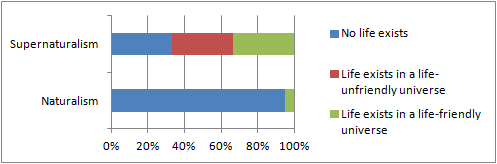
With this modification, I&J find that if the universe is life-friendly, this is evidence against the supernatural. This is easy to see in the above figure. If we rule out a life-unfriendly universe (the red bar), this decreases the likelihood of supernaturalism.
On the other hand, if we compare the size of the green bars, it seems like the FTA works. If the universe is life-friendly, that is evidence for naturalism. But if the universe has life in it, it seems like that's even stronger evidence for the supernatural. In formal terms, it appears that
Life-friendliness vs Life
The thing is, the distinction between "life exists" and "life can arise naturalistically" is a novel idea by I&J. It is definitely a useful distinction that improves our understanding of the problem. But I don't think FTA proponents ever make this distinction. FTA proponents are vague about it, and may not even know themselves whether they are arguing about life-friendliness or life-existence.
Therefore, when I&J say that FTA proponents are using life-friendliness as evidence, and not life-existence, this is totally groundless.
To understand the distinction between life-friendliness and the existence of life, it may help to consider how we might demonstrate life-friendliness. It's actually very difficult to demonstrate without any sort of presumption of naturalism. I&J indirectly mention the triple-alpha process, wherein the helium inside of stars fuse to carbon. Since the triple-alpha process is necessary to naturalistically produce carbon life-forms, Fred Hoyle predicted in the 1950s that there was a particular resonance which greatly increased the probability of the triple-alpha process. This prediction was later confirmed.
If FTA proponents are truly using life-friendliness as their evidence, they would point to Fred Hoyle's confirmed prediction. In Biologos treatment, they do discuss the triple-alpha process, but do not mention Hoyle's confirmed prediction. Instead they talk about how "statistically unusual" the resonance is.
Put in formal terms, I&J say that we should compare the quantities P(N|F&L) and P(N|L), because this is the correct comparison, and because this is the comparison described by FTA proponents themselves. But I think that FTA proponents are actually comparing P(N|F&L) and P(N). Furthermore, I think FTA proponents have chosen the correct comparison, whereas I&J have chosen the wrong one.
Trickiness with priors
"Prior commitment" sounds bad, like you've decided your conclusions before you've considered the evidence. But generally speaking, there's nothing wrong with coming to conclusions without evidence, if you have an a priori argument. Since FTA proponents are arguing about the quantity P(N|L), which I&J call a prior probability, we could say that FTA is partly an a priori argument.
Is it really true that the FTA is an a priori argument? If the only evidence advanced is the existence of life, then the FTA is quite similar to the cosmological argument. The cosmological argument only advances the evidence that there exists something rather than nothing. Is the cosmological argument considered an a priori argument? The internet consensus seems to be not.4
If the FTA is not an a priori argument, then I&J have made an error in using P(N|L) as our prior belief, rather than P(N). If the FTA is an a priori argument, then I&J have basically ignored the a priori component of it, and no wonder that what remains is so unconvincing.
Of course, it seems like FTA proponents really are trying to advance some sort of evidence, and that's why they talk about universal constants and the triple-alpha process. I propose that what's happening is that we're actually comparing three meta-theories:

By eliminating the naturalistic theories where fine-tuning is not necessary, it seems we greatly reduce the probability of life existing within naturalism.
Conclusion (TL;DR)
Ikeda and Jefferys refute the Fine-Tuning argument by making an interesting and useful distinction between universes with life, and universes where life can arise naturally. According to them, it is only necessary to consider the evidence that life can arise naturally. The problem is that this ignores the main thrust of the Fine-Tuning argument.
To refute the Fine-Tuning argument, we must discuss its many other problems, and not the particular problem put forth by Ikeda and Jefferys.
--------------------------------------------
1. Also see the same paper hosted on a different website with inferior design, but with the extra Appendix 2.
2. If you are unfamiliar with the formalism of conditional probabilities, you can read up on it. In this post, I will try to minimize formalism, but it is impossible to eliminate it entirely.
3. The only assumption is that P(~F&L&N) = 0, which is true from the definition of F.
4. See here, here, and here, all search results for the cosmological argument.
To briefly summarize I&J, they formulate the FTA in bayesian terms. We already know that life exists, as part of our background knowledge. The new piece of evidence put forth by the FTA is that the universe is such that life may arise naturalistically (ie it is "life-friendly"). I&J say the problem is that this evidence argues against supernaturalism, not in favor of it. After all, in a naturalistic world, we must observe that the universe is life-friendly. In a supernaturalistic world, we might observe otherwise, since supernatural intervention can create or sustain life even when natural laws are not life-friendly.
In formal terms:2
N = universe is naturalisticI think their theorem is basically incontrovertible,3 and I do not contest it. However, I feel it is missing the point. Here I aim to explain why.
L = life exists
F = universe is life-friendly
I&J show that
P(N|F&L) ≥ P(N|L)
Whereas the FTA requires that
P(N|F&L) << P(N|L)
What does the Fine-Tuning argument argue?
A schematic illustration of the Fine-Tuning argument. The two rows each represent a different meta-theory of the universe. The colored bars represent the probabilities of different events within those meta-theories.
The FTA asks us to compare two meta-theories of the universe: naturalism and supernaturalism. In a naturalistic universe, there's a very small probability that life can arise, because the universal constants need to be just right (or so the argument goes). In a supernatural universe, well, who knows?
I&J make two important points about this argument. First, they argue that the premise is irrelevant, and the conclusion is a fallacy. Formally:
Premise: P(F|N) << 1I checked to see if this is in fact the premise and conclusion used by FTA proponents. The Discovery Institute basically makes the following argument:
Fallacious conclusion: P(N|F) << 1
Premise: P(F|N) < P(F|~N)This is similar to the fallacious reasoning identified by I&J, only it's not fallacious. It's correct. But it requires a stronger premise. Namely, we have to assume that the probability of life under naturalism is less than the probability of life under supernaturalism (as illustrated above).
Conclusion: P(N|F) < P(N)
I believe that I&J reject this stronger premise, and I think this is reasonable. Who is to say that a deity would be particularly likely to arrange the universe such that it contains life? There are an infinite number of possible deities which each prefer a different configuration of the universe. If we only speak of deities that have an inclination towards universes with life, then they're likely to create life, but this is just some sort of selection bias on our part.
But even though I tentatively agree with I&J's first point, I will ignore it for the rest of the post, because I wish to evaluate how their second point stands on its own.
I&J's second point is that we need to include all evidence in our Bayesian. We know two things: life exists, and life can arise. The probability of naturalism should be conditioned on both these facts, not just one or the other. Formally:
FTA argues that P(N|F) > P(N)
But the relevant comparison is between the quantitities P(N|F&L) and P(N|L)
On the other hand, if we compare the size of the green bars, it seems like the FTA works. If the universe is life-friendly, that is evidence for naturalism. But if the universe has life in it, it seems like that's even stronger evidence for the supernatural. In formal terms, it appears that
P(N|F&L) ≥ P(N|L) << P(N)And that's why I feel I&J have missed the point.
Life-friendliness vs Life
The "fine tuning" argument isn't "What do you think about God, when you learn that you are alive?" but "What do you think about God, when you learn that the universe is (apparently) fine-tuned or life-friendly?"As in the quote above, I&J believe that the only piece of evidence advanced by the FTA is that the universe is life-friendly. The existence of life is not a piece of evidence, because we already knew life existed.
--Ikeda & Jefferys
The thing is, the distinction between "life exists" and "life can arise naturalistically" is a novel idea by I&J. It is definitely a useful distinction that improves our understanding of the problem. But I don't think FTA proponents ever make this distinction. FTA proponents are vague about it, and may not even know themselves whether they are arguing about life-friendliness or life-existence.
Therefore, when I&J say that FTA proponents are using life-friendliness as evidence, and not life-existence, this is totally groundless.
To understand the distinction between life-friendliness and the existence of life, it may help to consider how we might demonstrate life-friendliness. It's actually very difficult to demonstrate without any sort of presumption of naturalism. I&J indirectly mention the triple-alpha process, wherein the helium inside of stars fuse to carbon. Since the triple-alpha process is necessary to naturalistically produce carbon life-forms, Fred Hoyle predicted in the 1950s that there was a particular resonance which greatly increased the probability of the triple-alpha process. This prediction was later confirmed.
If FTA proponents are truly using life-friendliness as their evidence, they would point to Fred Hoyle's confirmed prediction. In Biologos treatment, they do discuss the triple-alpha process, but do not mention Hoyle's confirmed prediction. Instead they talk about how "statistically unusual" the resonance is.
Put in formal terms, I&J say that we should compare the quantities P(N|F&L) and P(N|L), because this is the correct comparison, and because this is the comparison described by FTA proponents themselves. But I think that FTA proponents are actually comparing P(N|F&L) and P(N). Furthermore, I think FTA proponents have chosen the correct comparison, whereas I&J have chosen the wrong one.
Trickiness with priors
But what is P(N|L)/P(~N|L)? Why, it is just the prior odds ratio that You assign to describe Your relative belief in N and ~N before You learn that F is true.According to I&J, our prior beliefs are based on our knowledge that life exists. We think, therefore we are. Therefore, if upon seeing that life exists, you think that supernaturalism is more likely than naturalism, then you have a "prior commitment" to supernaturalism.
--Ikeda & Jefferys
"Prior commitment" sounds bad, like you've decided your conclusions before you've considered the evidence. But generally speaking, there's nothing wrong with coming to conclusions without evidence, if you have an a priori argument. Since FTA proponents are arguing about the quantity P(N|L), which I&J call a prior probability, we could say that FTA is partly an a priori argument.
Is it really true that the FTA is an a priori argument? If the only evidence advanced is the existence of life, then the FTA is quite similar to the cosmological argument. The cosmological argument only advances the evidence that there exists something rather than nothing. Is the cosmological argument considered an a priori argument? The internet consensus seems to be not.4
If the FTA is not an a priori argument, then I&J have made an error in using P(N|L) as our prior belief, rather than P(N). If the FTA is an a priori argument, then I&J have basically ignored the a priori component of it, and no wonder that what remains is so unconvincing.
Of course, it seems like FTA proponents really are trying to advance some sort of evidence, and that's why they talk about universal constants and the triple-alpha process. I propose that what's happening is that we're actually comparing three meta-theories:
By eliminating the naturalistic theories where fine-tuning is not necessary, it seems we greatly reduce the probability of life existing within naturalism.
Conclusion (TL;DR)
Ikeda and Jefferys refute the Fine-Tuning argument by making an interesting and useful distinction between universes with life, and universes where life can arise naturally. According to them, it is only necessary to consider the evidence that life can arise naturally. The problem is that this ignores the main thrust of the Fine-Tuning argument.
To refute the Fine-Tuning argument, we must discuss its many other problems, and not the particular problem put forth by Ikeda and Jefferys.
--------------------------------------------
1. Also see the same paper hosted on a different website with inferior design, but with the extra Appendix 2.
2. If you are unfamiliar with the formalism of conditional probabilities, you can read up on it. In this post, I will try to minimize formalism, but it is impossible to eliminate it entirely.
3. The only assumption is that P(~F&L&N) = 0, which is true from the definition of F.
4. See here, here, and here, all search results for the cosmological argument.
Subscribe to:
Posts (Atom)


